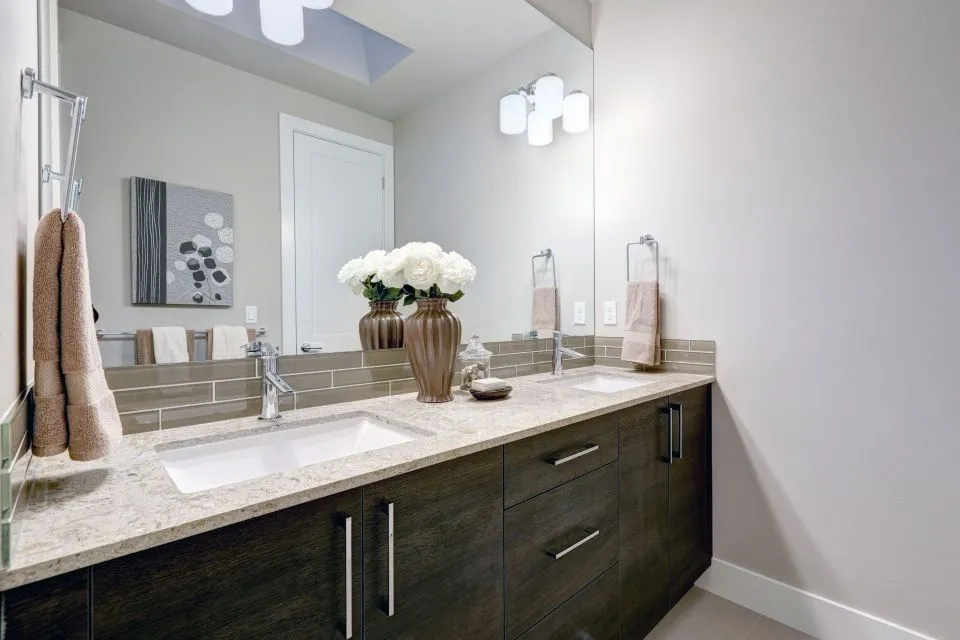
Creating a luxury bathroom with quartz countertops and sinks
A luxury bathroom should feel considered from every angle. The materials need to look beautiful under natural and artificial light, withstand daily moisture, and support the routines that happen there every morning and evening. Quartz countertops provide a strong foundation for that balance, especially when paired with a custom sink, coordinated shower surfaces, and carefully selected hardware.
Unlike a purely decorative upgrade, a well-designed bathroom improves storage, cleaning, comfort, and resale appeal. A quartz vanity top can establish the room’s color palette while connecting the vanity to the shower, tub surround, backsplash, or window ledge. The result is a space that feels unified rather than assembled from unrelated finishes.
For homeowners in North Little Rock and surrounding Arkansas communities, professional fabrication is an important part of the process. Accurate measurements, thoughtful edge profiles, sink cutouts, and polished seams determine whether an expensive material looks truly luxurious after installation.
Start with a refined material palette
Quartz is an engineered stone made from mineral content, resins, and pigments. Its controlled manufacturing process allows for consistent color and pattern, making it easier to coordinate a bathroom design than many naturally variable stones. Current quartz collections range from soft white and warm ivory to dramatic charcoal, gray veining, and stone-inspired patterns that resemble marble.
The best luxury bathrooms usually rely on a restrained palette. A creamy quartz vanity top can work with brushed brass fixtures, warm wood cabinetry, and beige porcelain tile. A cool white surface may suit chrome, polished nickel, glass, and pale gray walls. Dark quartz can create a dramatic focal point, particularly when balanced with lighter flooring and generous lighting.
Color should be evaluated in the actual bathroom rather than selected from a small sample alone. Vanity lights, daylight, wall paint, tile grout, and cabinet finish can all change how the surface appears. Large samples or slab viewing help reveal the movement of the pattern and show whether the veining will complement the room’s scale.
Quartz is also a practical choice for bathroom remodeling because its nonporous surface does not require routine sealing. It resists many common stains from cosmetics, toothpaste, and grooming products, though spills should still be wiped up promptly and harsh chemicals should be avoided.
Design the vanity around daily rituals
A luxury vanity begins with function. Before choosing a color, consider how many people use the room, whether the bathroom needs concealed storage, and how much counter space is required for toiletries. A shared primary bathroom may benefit from two sinks and separate drawer storage, while a compact guest bath may feel more spacious with a single basin and a narrow floating vanity.
Quartz gives designers flexibility around the vanity shape. A straight run is efficient and easy to furnish, while an L-shaped design can use an awkward corner or create a dedicated makeup area. A raised side splash, short backsplash, or full-height quartz backsplash can protect painted walls and create a more finished appearance.
The countertop edge is a small detail with a noticeable visual effect. A simple eased edge suits contemporary bathrooms and is comfortable against the body. A small bevel adds definition without appearing ornate, while a rounded edge can soften a traditional vanity. Elaborate profiles may work in a formal design, but they should support the cabinetry and architecture rather than compete with the stone.
The height of the vanity, location of outlets, faucet type, and mirror placement should be resolved before fabrication. These details influence sink positioning and countertop dimensions. Coordinating them early reduces the risk of awkward clearances or last-minute changes.
Pair quartz with an integrated sink
An integrated sink creates one of the cleanest expressions of a custom bathroom. Instead of placing a separate bowl on top of the counter, the sink is formed as part of the countertop or designed to connect with it in a seamless-looking configuration. Fewer transitions mean fewer visual interruptions and a simpler cleaning routine.
This approach is especially effective in modern, minimalist, and spa-inspired bathrooms. A white quartz surface with a matching sink can make a compact vanity look larger, while a contrasting basin can add architectural definition. Depending on the design and fabrication method, options may include a trough-style basin, a single-bowl sink, or a custom arrangement for a double vanity.
Sink selection should account for more than appearance. The basin needs appropriate depth, drainage, faucet compatibility, and splash control. The countertop fabricator and plumber should coordinate the faucet holes, drain position, water lines, and cabinet support before production begins. A beautiful surface cannot compensate for a sink that is uncomfortable to use or difficult to service.
Undermount sinks are another popular option for quartz bathroom counters. The rim sits below the countertop, allowing water and debris to be swept directly into the basin. This creates a crisp transition and works well with many quartz patterns. The cutout must be precise, and exposed edges around the opening should be smoothly finished for comfort and durability.
Coordinate shower walls and finishing details
A bathroom feels especially luxurious when the vanity does not stand alone. Quartz can connect the sink area to shower walls, niche shelves, tub surrounds, and other wet-zone features. Using a related color or pattern throughout the room creates continuity without requiring every surface to match exactly.
Large-format porcelain and quartz-inspired tile can complement a quartz vanity while adding a different texture or scale. For example, a gently veined quartz counter may pair with large matte porcelain shower panels and a small mosaic shower floor. This combination keeps the room visually layered while avoiding an overly busy pattern mix.
For a more dramatic design, the same quartz pattern can continue from the vanity backsplash up a feature wall or into a shower niche. Bookmatched slabs may create a symmetrical statement in a spacious bathroom, while a simple continuation of the counter material can make a narrow room appear more open. The layout of the veining should be planned before cutting so important patterns do not disappear into plumbing penetrations or corners.
| Design choice | Visual effect | Practical consideration | Suitable setting |
|---|---|---|---|
| White quartz with subtle veining | Bright, calm, and spacious | Shows dust and water spots more readily | Primary or guest bathrooms |
| Warm beige quartz | Soft, welcoming, and timeless | Coordinates best with warm tile and wood | Traditional or transitional spaces |
| Dark quartz | Dramatic and sophisticated | Needs strong lighting and balanced lighter finishes | Large primary bathrooms |
| Integrated quartz sink | Minimal and seamless | Requires precise fabrication and compatible plumbing | Contemporary vanities |
| Quartz backsplash or shower accent | Creates material continuity | Pattern layout should be planned in advance | Custom remodels and spa-style rooms |
Lighting should be planned alongside the stone. Vertical sconces at the sides of a mirror provide more flattering illumination than a single overhead fixture, while recessed ceiling lights support general visibility. Under-cabinet lighting can highlight a floating vanity and make the countertop edge appear to hover above the floor.
Make luxury practical and lasting
Luxury is easier to enjoy when maintenance is straightforward. Quartz bathroom surfaces can generally be cleaned with a soft cloth, warm water, and a mild pH-neutral cleaner. Abrasive powders, scouring pads, strong solvents, and products containing bleach or acids may damage the finish or discolor resin components.
Although quartz is highly resistant to moisture and everyday staining, it is not indestructible. Do not use the countertop as a cutting surface, stand on it, or place extremely hot styling tools directly on it. Hair tools should rest on a heat-resistant mat, and standing water around faucets should be dried when convenient.
The installation environment also affects long-term performance. Cabinets need to be level, adequately supported, and firmly secured before the slab arrives. Walls should be checked for irregularities, especially in older homes where corners may not be perfectly square. Proper support is essential for overhangs, makeup ledges, and areas near sink cutouts.
A durable design also leaves room for service access. Plumbing shutoff valves should remain reachable, and drawers should not block drain connections. If a wall-mounted faucet or specialty sink is planned, the framing and water lines need to be completed correctly before the countertop is installed.
Plan fabrication and installation carefully
Custom countertop work follows a sequence that usually includes design consultation, material selection, field measurement, templating, fabrication, finishing, and installation. Each stage affects the next. A small change to cabinet placement can alter the sink location, backsplash dimensions, or slab layout.
Templating is particularly important in bathroom remodeling. It captures the actual dimensions of the room, including wall angles, cabinet setbacks, plumbing openings, and irregular corners. Digital or physical templates help the fabricator determine where seams, cutouts, and edge details should appear.
Homeowners should review the slab layout before fabrication when the quartz has pronounced veining. The direction of movement can change the character of the vanity, and a small remnant may be useful for a shelf, niche, or matching backsplash. Discussing these details early can prevent a pattern from being placed in an unintended position.
Installation should be handled by an experienced team familiar with quartz and bathroom conditions. The crew will set the counter, verify the sink fit, join seams where necessary, apply appropriate sealants at wall transitions, and coordinate with the plumber for final connections. A careful installation protects the investment and gives the material the clean, tailored appearance associated with a high-end remodel.
Reviewing previous workmanship can help homeowners understand what to expect from the process. The Countertop Store’s customer testimonials offer useful insight into communication, craftsmanship, and completed remodeling projects.
Details worth specifying early
The most successful bathroom renovations resolve small decisions before they become construction problems. Make a written materials and fixture schedule that identifies the countertop, sink, faucet, cabinet finish, wall tile, hardware, mirrors, lighting, and grout. This makes it easier to see whether the finishes work together and helps each contractor follow the same plan.
It is also useful to decide how much visual emphasis the quartz should carry. A quiet surface allows patterned tile or decorative lighting to take the lead. A strongly veined slab may serve as the room’s primary feature, with simpler cabinetry and walls supporting it. Both approaches can feel luxurious when the proportions and transitions are intentional.
- Choose quartz after reviewing full-size patterns, lighting conditions, and surrounding tile.
- Confirm sink dimensions, faucet holes, cabinet support, and plumbing access before templating.
- Select an edge profile that complements the vanity style and remains comfortable to use.
- Plan backsplashes, shower niches, and slab direction before fabrication begins.
- Use mild, nonabrasive cleaning products and protect the surface from direct heat.
A custom bathroom becomes memorable through coordination: a sink that sits comfortably within the vanity, a countertop pattern that aligns with the room, and shower surfaces that feel connected without becoming repetitive. For homeowners ready to discuss measurements, material options, or a complete remodeling surface package, schedule a design consultation with The Countertop Store serving North Little Rock and nearby areas. Start with the room’s needs, then let the quartz, cabinetry, lighting, and craftsmanship shape a space that feels polished every day.