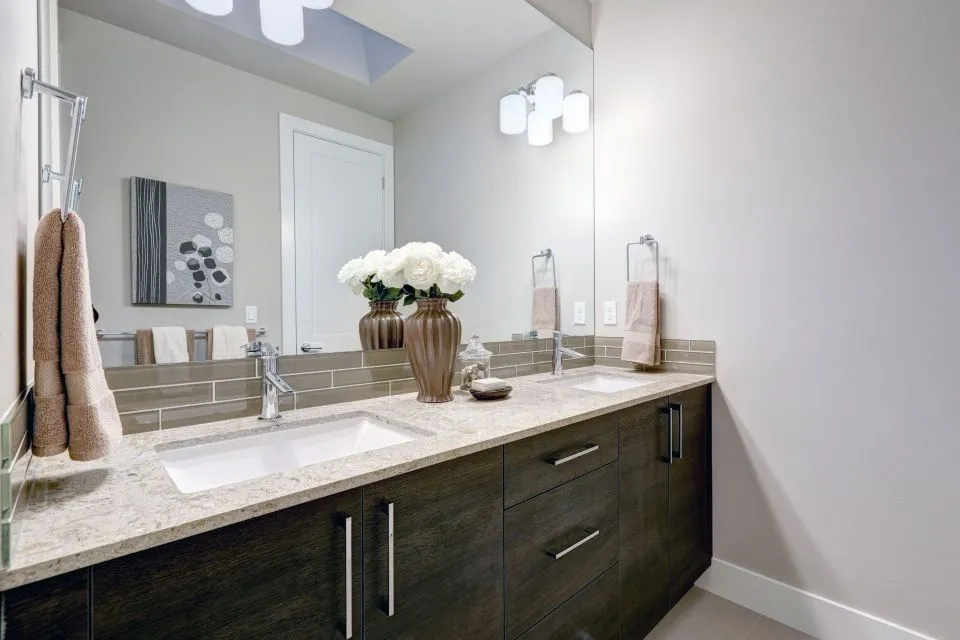
Custom shower walls that complement your countertops
A bathroom feels more intentional when its surfaces relate to one another. Custom shower walls can carry the same color family, veining, texture, or edge detail found in a vanity countertop, creating a continuous design from the sink area to the shower enclosure. The result is a space that looks planned rather than assembled from unrelated finishes.
Matching does not require every surface to be identical. A quartz vanity may pair beautifully with porcelain shower panels that echo its soft gray movement, while a granite countertop can work with a quiet solid-color wall surface. The goal is visual balance, practical performance, and a finish that suits the way your household uses the room.
For homeowners in North Little Rock, Arkansas, a coordinated bathroom remodel also benefits from professional measurement and fabrication. The Countertop Store can help connect material selection, shower wall dimensions, integrated features, and installation details so the finished design works as a complete space.
Start with the countertop as the design anchor
The vanity countertop often occupies the most prominent horizontal area in a bathroom, making it a useful starting point for the shower design. Examine its background color first, then identify secondary tones in the veining or pattern. Those quieter colors can guide the shower surround, niche, trim, and floor selections without creating a visually busy room.
A dramatic marble-look quartz, for example, may be best balanced by large-format shower walls with restrained veining. If the countertop has a warm white base and taupe movement, a shower panel in a related ivory, beige, or pale greige can make the room feel larger. For a darker granite, lighter shower walls can provide contrast while small accents repeat the countertop’s charcoal, brown, or metallic notes.
Texture matters as much as color. A polished vanity surface works well with smooth shower panels when you want a clean, contemporary appearance. Honed stone or a matte porcelain wall can soften the reflection and add depth, especially in bathrooms with natural wood cabinetry or brushed metal fixtures.
Select a surface that suits the shower
Quartz, porcelain, granite, marble, Dekton, and other engineered or natural materials each bring a different combination of appearance, maintenance, and fabrication possibilities. Shower walls must withstand regular moisture, cleaning products, temperature changes, and daily contact, so the material should be chosen for service conditions as well as style.
Porcelain slabs and large-format porcelain tile are popular for shower surrounds because they can imitate marble, concrete, limestone, and other finishes while reducing the number of grout joints. Quartz offers a broad color range and can coordinate directly with a quartz vanity, though the specific product should be evaluated for appropriate shower use. Natural stone provides authentic variation and character, but it may require sealing and a care routine suited to the stone.
Solid surface options can create a calm, nearly seamless appearance and may be fabricated with matching accessories. A coordinated quartz shower pan, bench, niche shelf, or integrated sink can carry the countertop palette through several parts of the bathroom. Discussing these details before fabrication helps avoid a design where the walls coordinate in color but conflict in thickness, edge profile, or undertone.
Match the visual language, not every detail
A cohesive bathroom usually depends on repetition with restraint. Repeat one or two meaningful elements, such as a countertop’s background color and a subtle vein direction, then allow other features to provide contrast. Using the exact same pattern everywhere can make a compact bathroom feel overwhelming, especially when the selected material has bold movement.
Edge profiles offer another way to connect surfaces. A simple eased edge on the vanity can relate to a clean-lined shower bench or niche shelf. More decorative countertop edging may be reserved for the vanity while the shower remains visually quiet. This keeps the countertop distinctive without forcing every architectural detail to compete for attention.
Hardware, plumbing fixtures, and lighting should support the material relationship. Warm stone tones often pair naturally with aged brass or brushed nickel, while cool gray surfaces can work with chrome, matte black, or stainless accents. Grout color deserves equal care: a close match creates a monolithic look, while contrasting grout emphasizes tile layout and can make the wall feel busier.
| Countertop material or style | Shower wall pairing | Design effect | Practical note |
|---|---|---|---|
| White quartz with fine gray veining | Large-format porcelain in white, gray, or soft greige | Bright and streamlined | Fewer grout lines simplify cleaning |
| Bold marble-look quartz | Quiet porcelain or solid-color slab | Keeps dramatic veining focused | Confirm undertones under bathroom lighting |
| Warm granite | Beige, cream, taupe, or earthy stone-look wall | Comfortable and grounded | Sealing requirements may differ by material |
| Dark soapstone or charcoal surface | Pale stone-look porcelain or light quartz | Strong contrast with a spacious feel | Plan lighting to prevent a shadowed enclosure |
| Butcher block or wood-look vanity | Matte stone-look porcelain in warm neutrals | Adds organic, spa-inspired character | Use moisture-appropriate materials near wet areas |
| Concrete-look or modern Dekton surface | Minimal gray slab or coordinated porcelain | Architectural and contemporary | Keep trim and hardware simple |
Design around niches, benches, and transitions
The shower wall is more than a broad background. Niches, benches, curb caps, wall ledges, and shampoo shelves create opportunities to repeat the countertop material in purposeful ways. A stone shelf that matches the vanity can act as a visual bridge, while a contrasting niche back can add depth without changing the entire surround.
A custom-fabricated niche may be designed with a countertop remnant, a separate slab, or a coordinated porcelain piece. The shelf needs appropriate slope for drainage and careful waterproofing at every junction. When the material is selected early, the fabricator and installer can account for thickness, finished edges, corner details, and the relationship between the niche and the wall pattern.
Shower pans deserve the same attention. A quartz shower pan or solid-surface base can coordinate with the vanity while offering a low-maintenance alternative to numerous floor tiles. It should be sized and sloped correctly, with the drain location confirmed before fabrication. Matching the pan to the countertop can make the lower portion of the enclosure feel deliberately connected to the rest of the bathroom.
Balance scale, pattern, and room size
Large-format shower panels can make a small bathroom appear more open because broad surfaces reduce visual interruptions. They also influence how the countertop is perceived. If the vanity has a fine pattern, a larger wall format can create an airy backdrop. If both surfaces contain strong movement, the room may benefit from a simpler floor, backsplash, or painted wall color.
In a larger primary bathroom, mixing formats can define zones. A slab-style wall may cover the main shower area, while a smaller mosaic appears on the niche back or shower floor. The mosaic can draw from a secondary countertop color without introducing a separate design language. A horizontal accent band may also work, though its placement should align with fixtures and architectural lines.
Sample review is essential because material colors change under daylight, vanity lighting, and recessed shower fixtures. Hold countertop and shower samples beside the cabinet finish, flooring, grout, and metal selections. A gray that looks neutral in a showroom may read blue beside a warm white countertop, while beige stone may appear pink next to certain wood tones.
Coordinate fabrication with installation
A polished result depends on accurate field measurements, a reliable template, and clear decisions about seams and finished edges. Shower walls must account for out-of-square corners, plumbing penetrations, niches, doors, benches, and the thickness of waterproofing systems. Vanity countertops require their own measurements for sinks, faucets, backsplashes, and wall conditions.
Fabrication and installation should be coordinated as one process rather than treated as unrelated appointments. A professional team can review the layout, confirm material availability, identify vulnerable corners, and determine where seams will be least noticeable. This is especially important with heavy slabs, large porcelain panels, and designs that require precise veining alignment.
Homeowners planning a bathroom remodel can schedule a consultation to discuss material samples, shower wall layouts, quartz shower pans, integrated sinks, and custom edging. Early planning gives the fabricator time to coordinate measurements and helps the homeowner make choices before tile, plumbing, and cabinetry work limit the available options.
Practical choices for a coordinated bathroom
A beautiful surface still needs to perform well after years of use. Consider how often the shower is used, whether children or guests will share it, how much maintenance is realistic, and whether the room has ventilation concerns. Smooth, low-porosity surfaces are often easier to wipe down, while heavily textured finishes can hold soap residue and mineral deposits.
Pay close attention to cleaning instructions. Natural marble and some other stones may be sensitive to acidic products, while engineered materials have manufacturer-specific limitations. Seams should be sealed appropriately, corners should be detailed to limit water intrusion, and the waterproofing system behind the wall surface should be treated as a critical part of the installation.
Keep these recommendations in mind when narrowing the design:
- Use the countertop’s background color as the primary connection and reserve bold veining for a controlled focal point.
- Compare physical samples in the actual bathroom under both natural and artificial light.
- Choose large-format panels or tile layouts that reduce unnecessary grout while fitting the wall dimensions.
- Repeat the countertop material in a niche shelf, bench, curb cap, or shower pan instead of covering every surface with the same pattern.
- Confirm waterproofing, seam placement, edge finishing, and cleaning requirements before fabrication begins.
Bring the surfaces together
A coordinated shower and vanity can give a bathroom the feeling of a custom-designed retreat while still allowing each area to have its own purpose. The strongest combinations usually share a color relationship, repeat a carefully selected material detail, and use contrast where it improves scale and function.
The Countertop Store serves North Little Rock and surrounding communities with consultation, measurements, templating, fabrication, edging, and installation for bathroom surfaces. Bring your countertop ideas, cabinet samples, inspiration images, or remodeling plans to the design process, and work with a local team to develop shower walls that feel connected from the first glance to the final detail.