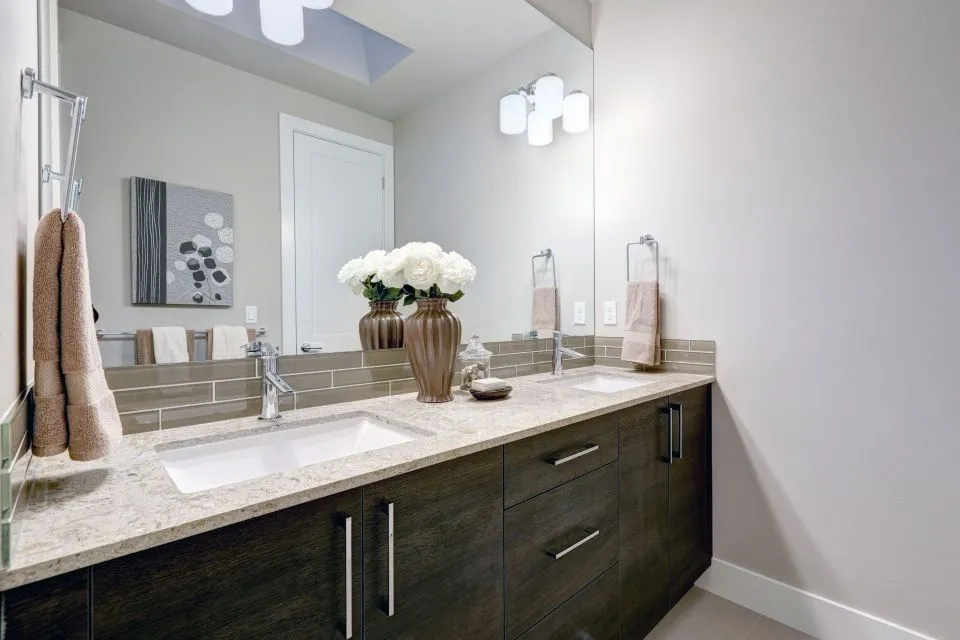
Achieving a minimalist look with a thin quartz countertop edge
A thin quartz countertop edge has become one of the most quietly powerful design choices in contemporary Australian homes. Where thick, ornate slabs once dominated kitchens and bathrooms, designers and renovators from Sydney to Perth are now turning toward slimmer profiles that let the surrounding architecture breathe. The result is a cleaner sightline, less visual weight, and a surface that supports rather than competes with cabinetry, lighting, and finishes.
The appeal goes beyond aesthetics. Engineered quartz allows fabricators to produce remarkably slender edges without sacrificing strength, opening the door to refined details like mitered aprons, waterfall returns, and flush-mounted splashbacks. For homeowners planning a renovation or a new build, understanding how a thin edge changes the feel of a room is the first step toward a genuinely minimalist space.
Why thin edges work so well in minimalist interiors
Minimalism relies on the careful removal of unnecessary detail. A countertop with a chunky, heavily bevelled edge introduces a strong horizontal line that draws the eye and signals visual weight. Replace it with a slim, square profile and the benchtop almost disappears into the room, becoming a quiet platform rather than a focal point. This shift is particularly effective in compact apartments across Melbourne and Brisbane, where every millimetre of perceived depth influences how spacious a kitchen feels.
There is also a psychological dimension to consider. Slim edges read as modern, considered, and deliberate, which aligns with the values most homeowners associate with minimalist design: restraint, precision, and longevity. A thin quartz countertop edge pairs naturally with flat-panel cabinetry, handleless drawers, and integrated appliances, allowing each element to contribute without crowding the composition.
In open-plan living areas that flow into alfresco zones, a slim edge helps the kitchen transition smoothly outdoors. Australians who entertain frequently appreciate how a delicate profile feels less intrusive on views toward the garden or pool area, keeping the eye focused on the landscape beyond the glass doors.
Selecting the right quartz slab for a slim profile
Not every quartz product behaves the same way when reduced to a thin edge. The composition of the slab, the density of the aggregate, and the manufacturer's pressing process all affect how cleanly a fabricator can cut and finish a narrow profile. Premium engineered quartz, made under high pressure and vacuum conditions, holds its shape along a mitred or square edge far better than lower-density alternatives, which can chip or flake during polishing.
When considering options for a minimalist project, it pays to explore the full range of quartz surfaces available through established suppliers. Reviewing the curated selection of materials offered by an experienced fabricator gives a clearer picture of which products produce the density and colour consistency needed for slim detailing. Whites, soft greys, and warm neutrals with subtle veining tend to read more cleanly along a thin edge than heavily patterned slabs, which can look fragmented when viewed in cross-section.
It is also worth noting that quartz manufacturers often specify a minimum recommended edge thickness. Some allow edges as slim as 12 millimetres when paired with a structural substrate, while others recommend a minimum of 20 millimetres even for minimalist designs. A knowledgeable fabricator familiar with international manufacturing standards will guide homeowners toward products that suit slim detailing while remaining structurally sound for daily use in family kitchens.
Edge profiles that reinforce a minimalist palette
The profile itself plays a defining role in how thin the benchtop actually appears. A squared edge, sometimes called a flat or eased edge, presents the slab at its narrowest visible width and remains the most popular choice for minimalist kitchens. It reflects light evenly and avoids any decorative shadow line, contributing to a calm, orderly composition across the entire room.
A mitered edge offers a different kind of minimalism. By joining two pieces of quartz at a 90-degree angle, fabricators create the illusion of a much thicker slab while still maintaining a slim visible front. This approach is often used on waterfall ends, where the benchtop flows down to the floor, or on islands that require a more substantial appearance without abandoning the clean aesthetic. The mitered join requires precise CNC cutting and skilled hand-finishing to remain virtually invisible.
For bathrooms and laundry rooms, a gently pencil-rounded edge softens the look without introducing ornament. The radius is usually only one or two millimetres, which is enough to remove the sharpness from the corner while preserving the overall slenderness. Across Australian renovations, this profile is favoured in apartments where rounded edges are required by strata guidelines for safety in compact wet areas.
Colour and finish choices to support the slim look
Colour and finish decisions amplify or diminish the impact of a thin quartz countertop edge. Matte and honed finishes scatter light rather than reflecting it, which makes the edge feel even less prominent. Glossy polished finishes, by contrast, create a defined highlight along the edge that draws attention to its exact dimensions. Homeowners chasing a quieter result often lean toward matte, especially in open kitchens where reflections can become visually busy.
Pale colours reinforce the minimalist intent. Whites with soft warm undertones, gentle creams, and pale greys blend seamlessly with light-coloured cabinetry popular in coastal homes from Sydney's eastern suburbs to Fremantle. Where stronger contrast is desired, a darker quartz paired with white cabinetry creates a strong horizontal line that becomes the room's anchor, much like a piece of furniture placed against a neutral wall.
Veining should be considered carefully. Bold, high-contrast veins look striking but can interrupt the calm rhythm of a minimalist space, especially where the benchtop wraps around corners or drops into a waterfall. Softer, more dispersed veining reads as a gentle texture rather than a feature, allowing the slim edge to do its work quietly in the background.
Pairing the benchtop with cabinetry and splashbacks
A thin edge rarely stands alone. It needs supporting players that share its design vocabulary. Flat-panel cabinetry with integrated or recessed handles is the most reliable companion, as it continues the clean lines established by the benchtop. Shaker-style doors, while charming, introduce a small framed detail that can feel at odds with the streamlined benchtop, particularly in compact galley kitchens common in inner-city Melbourne terraces.
Splashbacks benefit from the same restraint. A full-height slab splashback in matching quartz removes the visual interruption of grout lines and lets the benchtop and wall read as a single continuous surface. Glass splashbacks achieve a similar effect, although they introduce a reflective plane that can compete with the benchtop's matte finish if the two surfaces are placed in direct visual opposition.
Lighting also matters. Recessed LED strips beneath wall-hung vanities or overhead cabinetry cast a soft wash across the benchtop surface, highlighting the slim edge without creating harsh reflections. In Australian homes where natural light is abundant, this works particularly well, with north-facing kitchens in Adelaide and Brisbane catching gentle daylight that flatters matte quartz throughout the day.
Installation realities in Australian homes
Thin quartz edges demand careful handling during measurement, templating, and installation. Australian homes present a few specific considerations worth understanding. Many period properties in suburbs like Paddington and Fitzroy have walls that are not perfectly square, which means templating must be laser-accurate to ensure the slim edge meets cabinetry without unsightly gaps. A digital template, combined with CNC cutting, allows fabricators to achieve tolerances within a fraction of a millimetre.
Transport is another factor. Engineered quartz is heavy, and a slim edge, while structurally sound once installed, is more vulnerable to chipping during delivery if not properly supported. Reputable installers use A-frame transport rigs and edge-protective wrapping, particularly for the long spans common in open-plan kitchens from the Gold Coast to Geelong.
Building codes also play a role. The National Construction Code sets out requirements for benchtops in wet areas, particularly around sealing, support spans, and fall angles for drainage. A slim edge reduces the benchtop's overall weight, which can simplify support requirements in upper-floor apartments where load limits apply. Homeowners renovating in strata-titled buildings should also confirm any by-laws covering modifications to wet areas, as some schemes require committee approval before fabrication begins.
Care, longevity, and everyday use
Quartz is widely appreciated for being one of the lowest-maintenance benchtop materials, and this advantage carries over to thin-edge designs. The non-porous surface resists staining from coffee, wine, and common kitchen acids, which matters in busy family homes where messes are an everyday occurrence. A simple wipe with warm water and a mild detergent is usually enough to keep the surface looking new for years.
A few habits extend the life of a thin-edge benchtop. Using trivets for hot cookware protects both the surface and the adhesive joints where slim edges meet substrates. Avoiding direct impact on the corners, particularly around sinks and cooktops, prevents the kind of chipping that can occur when heavy pots are dropped during busy meal preparations. In outdoor kitchens, where many Australians enjoy year-round entertaining, a thin-edge quartz feature wall or integrated barbecue surround benefits from being specified with UV-stable resin, since standard quartz can yellow slightly under prolonged direct sun.
For households planning to stay in their homes long-term, the durability of quartz makes the minimalist investment worthwhile. Unlike painted cabinetry or tiled splashbacks, a well-fabricated quartz benchtop with a slim edge can look essentially unchanged for decades, aligning perfectly with the minimalist principle of choosing fewer, better things.