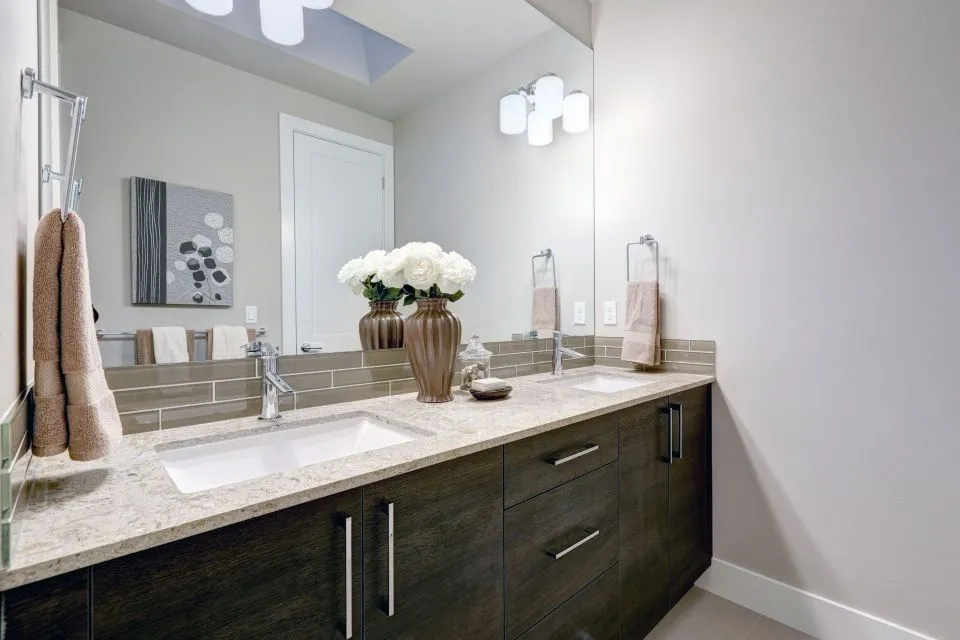
How to match your bathroom countertop to your shower wall material
Renovating a bathroom often starts with picking the benchtop, then the shower wall follows. In Australian homes, where ensuites are getting larger and open-plan layouts blur the line between the bedroom and the bathing zone, the visual relationship between these two surfaces matters more than ever. Whether you're working on a Federation semi in the inner suburbs or a new build along the Sunshine Coast, the right pairing turns a functional space into a calm, cohesive retreat.
Matching shower wall material to bathroom countertop is less about identical surfaces and more about creating a conversation between them. You can echo tones, contrast textures, or use the same slab in both locations with different finishes. The choice affects cleaning routines, long-term durability, and even resale value, especially in markets like Sydney and Brisbane where buyers expect a certain level of finish in the main bathroom.
Understanding material families and visual harmony
Every surfacing material belongs to a broader family, and pairing two surfaces from the same family almost always produces a balanced result. Quartz, granite, marble, porcelain, and Dekton each bring distinct visual signatures that read differently at benchtop scale versus full-height shower wall scale. A heavily veined marble might dominate as a feature wall but overwhelm when repeated across a long vanity, so understanding the visual weight of each option is the first step.
Stone suppliers in Adelaide and Perth often suggest starting with one hero surface and then selecting a complementary partner with at least 70 percent tonal overlap. This approach keeps the room grounded without becoming monotonous. When the two surfaces are too similar, the eye stops moving; when they clash in tone or finish, the bathroom can feel disjointed and busy, which is a common pitfall on reno shows hosted by well-known Aussie tradies.
Another consideration is the edge profile and how light plays across it. A mitred apron on the vanity can mirror the sharp lines of a large-format porcelain shower wall, while a softer bullnose edge pairs better with honed natural stone. Tradespeople in regional Victoria often recommend laying samples against each other in the actual room at different times of day, since Australian light can swing dramatically between morning glare and late-afternoon golden hour.
Considering light, space, and orientation
Australian bathrooms are often flooded with natural light, particularly in homes built around courtyards or with skylights above the shower. This is a blessing for design but a challenge for material selection, because intense UV exposure can yellow certain resins and fade pigments over time. A countertop that looks crisp white under showroom fluorescents might develop a creamy cast after years of direct sun, throwing off the original colour match with the shower wall.
North-facing bathrooms, common in Queenslander renovations and many Melbourne extensions, need materials with strong UV stability. Porcelain and quartz with high mineral content tend to perform well here, while some marble varieties can etch or discolour with prolonged exposure. South-facing rooms, especially those shaded by a Blue Mountains-style bushland block, generally allow for a broader palette, including darker soapstone or veined granite.
Ceiling height also dictates how bold the shower wall can be. A 2.4-metre ceiling in a compact apartment bathroom in Parramatta limits the scope of large-format slabs, while a soaring 2.7-metre void in a new build around Geelong invites a dramatic book-matched feature. Countertops in the same room should echo that sense of scale, either by staying subtle in a tall room or adding visual interest where the wall cannot.
Quartz pairings for a cohesive look
Quartz remains one of the most popular choices for bathroom benchtops in Australia because it resists staining and requires minimal upkeep. Pairing a Caesarstone or similar quartz benchtop with a quartz shower wall in a softer finish is a safe path, but it can read as flat if the veining is too uniform. Designers in Brisbane's new apartment developments often combine a directional quartz on the benchtop with a more cloud-like, subtle quartz on the wall to create depth.
The growing range of printed porcelain slabs that mimic natural stone gives renovators another way to coordinate surfaces without committing to either material twice. A grey veined porcelain on the shower wall can sit alongside a soft grey quartz benchtop with minimal veining, sharing the same undertone while differing in texture. This works particularly well in cost-conscious renovations in Hobart or Canberra, where the budget may not stretch to full natural stone on both surfaces.
Edge details matter when using engineered stone. A square-polished edge on the benchtop reads as a confident, contemporary choice and pairs naturally with large-format porcelain slabs that have crisp rectified edges. For period-style homes in Tasmania's heritage suburbs, a softer eased or pencil-round edge on the benchtop harmonises better with honed or leathered stone finishes on the shower wall.
Natural stone combinations
Natural stone brings organic variation that engineered products struggle to replicate, and it offers the most authentic material conversation between benchtop and shower wall. A Calacatta marble benchtop with a Carrara marble shower wall, for instance, can feel like a luxurious pairing, though the difference in veining intensity keeps the two surfaces distinct rather than repetitive.
Granite benchtops remain a staple in family homes across the Adelaide Hills and Barossa region, where darker speckled patterns hide the everyday smudges of busy households. Pairing a polished granite benchtop with a flamed or leathered granite shower wall in the same slab adds tactile contrast while keeping the colour story consistent. Sealing requirements are higher for natural stone, so homeowners should factor in a yearly reseal, especially in areas with hard water from bore supplies common in rural South Australia.
Soapstone and slate offer a more matte, earthy aesthetic that suits country-style renovations in the Southern Highlands or Mornington Peninsula. Soapstone darkens over time, which becomes part of its appeal, but the same patina will develop on both the benchtop and the shower wall if both are chosen in the same material. For those who prefer a steadier appearance, honed granite or quartzite provides a similar mood without the colour shift.
Porcelain and large-format slabs
Porcelain has surged in popularity for bathroom renovations in Australia because it shrugs off moisture, resists scratching, and tolerates harsh cleaning products. Large-format porcelain slabs, often 1200mm by 2400mm or larger, can clad a shower wall with virtually no grout lines, creating a clean canvas that pairs beautifully with both natural and engineered benchtops.
The design flexibility here is significant. A book-matched porcelain shower wall can act as the visual anchor, while a solid-colour quartz benchtop with a similar undertone quietly supports it. Conversely, a subtle porcelain wall can let a heavily patterned granite or Dekton benchtop take the spotlight. Renovators in coastal towns like Noosa or Byron Bay often choose sand-toned porcelain walls paired with pale terrazzo-look benchtops to echo the local beach palette.
Dekton, a sintered stone cousin of porcelain, offers similar benefits with greater thickness options for benchtops. Pairing Dekton shower walls with Dekton benchtops in a contrasting finish, such as a matte benchtop against a polished wall, creates a sophisticated tonal shift within a single material family. This approach has become a signature look in high-end new builds from the Gold Coast to inner Sydney.
Colour palettes that work across wet and dry zones
Choosing a colour palette that travels from the shower wall to the benchtop without feeling repetitive requires a clear plan. Warm whites with soft grey veining remain a classic Australian choice, working equally well in Hamptons-inspired renovations and minimalist apartments. Adding timber-look cabinetry or brushed brass tapware helps bridge the visual gap between the two surfaces.
For bolder schemes, deeper greens, moody charcoals, and earthy terracottas have entered the mainstream, partly influenced by Australian interior designers embracing outdoor colour stories. A forest-green soapstone benchtop can sit confidently beside a soft green porcelain shower wall without competing for attention, particularly when the wall features a gentle honed finish that softens the overall impact.
Neutral lovers can still find plenty of room to play. Soft beiges, mushroom tones, and putty greys create a calming spa-like atmosphere, especially when paired with stone-look porcelain on both surfaces. To avoid blandness, introduce variation through finish rather than colour: a polished benchtop against a honed wall, or a textured fluted tile beside a smooth slab, keeps the eye engaged without breaking the colour harmony.
Practical installation and maintenance considerations
Beyond looks, the practical realities of installing and maintaining matched surfaces often shape the final decision. Shower walls demand fully waterproof materials with proper substrate preparation, while benchtops need to handle dropped bottles, hot hair tools, and constant water exposure around the basin. Choosing materials that perform well in both roles simplifies long-term care for busy households.
Quartz and porcelain typically require the least maintenance, asking only for a wipe-down with mild cleaner. Natural stone, while beautiful, needs sealing and pH-neutral products to stay looking its best. In areas with mineral-heavy bore water, which is common across regional Western Australia and parts of Queensland, hard water spots show up quickly on polished surfaces, making honed finishes a more forgiving option for shower walls.
Working with a fabricator who templates, cuts, and installs both surfaces ensures tight mitres, consistent overhangs, and aligned edges where the benchtop meets a shaving cabinet or splashback. Homeowners weighing up the full project can see our process to understand how measurements, edging, and fitting come together in a single job. A coordinated install also reduces the risk of colour drift between batches, since slabs for both surfaces can be pulled from the same delivery.
| Material | Best for benchtop | Best for shower wall | Maintenance level | Visual match tips |
|---|---|---|---|---|
| Quartz | Polished finish, strong colours | Honed or suede finish | Low | Pair directional benchtop with cloud-pattern wall |
| Granite | Polished or leathered | Flamed, leathered, or polished | Medium (annual sealing) | Use same slab in different finishes |
| Marble | Polished or honed | Honed only | High (regular sealing) | Match undertone, vary veining intensity |
| Porcelain | Matte or polished | Large-format slabs | Very low | Use book-matched wall with solid benchtop |
| Dekton | Matte or polished | Polished or textured | Very low | Contrast finishes within same material |
| Soapstone | Honed | Honed | Medium (oiling) | Accept patina development on both surfaces |
| Butcher Block | Sealed or oiled | Not recommended | High | Use only on dry zones, pair with tile wall |