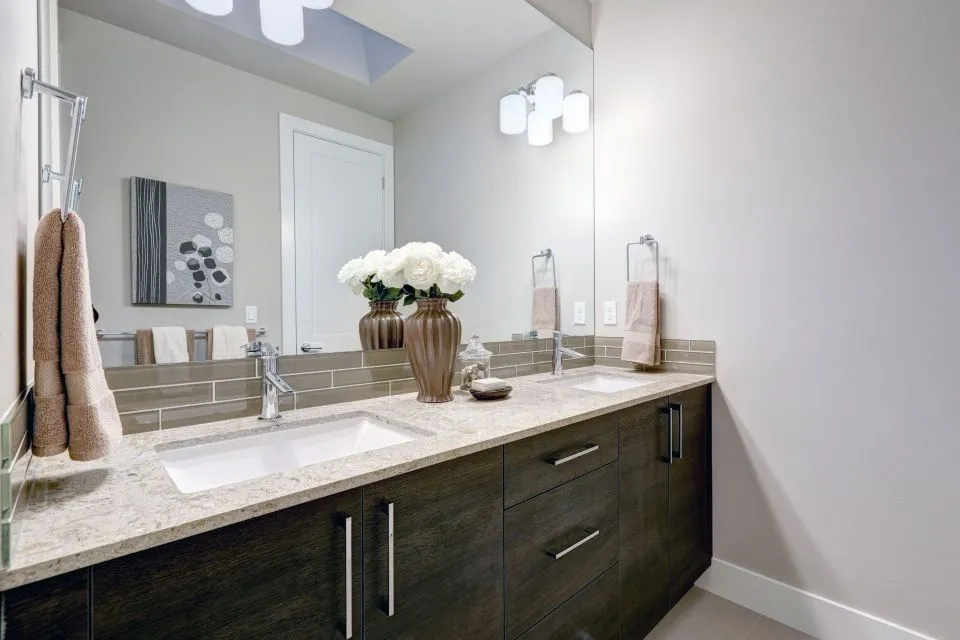
Granite Countertops with Chiseled Edges for Rustic Australian Homes
A granite benchtop with a chiseled edge brings natural texture and visual weight to a kitchen, bathroom, laundry, or outdoor entertaining area. The roughened profile softens the precision of modern cabinetry, making the room feel more connected to timber, brick, stone, and other organic materials. It can suit a country farmhouse, coastal cottage, mountain retreat, or contemporary Australian home that needs a warmer focal point.
Granite is especially appealing when a surface must look authentic while handling everyday use. Each slab has its own mineral movement, colour variation, and veining, while the chiseled or rock-face edge adds a hand-finished character. Selecting the right slab, edge treatment, sealing system, and supporting cabinetry helps the feature look intentional rather than unfinished.
| Edge style | Visual effect | Suitable interior | Maintenance consideration |
|---|---|---|---|
| Chiseled or rock-face | Irregular, rugged, handcrafted | Rustic, country, coastal, lodge-inspired | Textured areas need careful wiping |
| Eased | Simple, softly squared | Transitional and modern rustic | Easy to clean and maintain |
| Bullnose | Rounded and traditional | Classic family kitchens | Comfortable around busy walkways |
| Ogee | Decorative and formal | Heritage or ornate interiors | More detailed and visually prominent |
| Waterfall | Continuous slab down the side | Contemporary rustic or industrial | Requires precise fabrication and stronger support |
Why Granite Works with Rustic Design
Rustic interiors rely on materials that show variation rather than appearing perfectly uniform. Granite naturally provides that variation through speckles, mineral flecks, veining, and tonal shifts. A slab in leathered black, warm brown, charcoal, cream, or earthy green can become the bridge between painted joinery and natural finishes such as oak, recycled timber, terracotta, or exposed brick.
The stone also gives a kitchen a sense of permanence. Timber can dent, painted cabinets can mark, and laminate may eventually show wear, while a properly fabricated granite worktop offers a hard, durable surface for food preparation and family activity. Its solid appearance works particularly well in homes where the kitchen is used for long breakfasts, baking, entertaining, and informal gatherings.
Australian design often combines practical open-plan living with relaxed natural styling. In a Melbourne renovation, a dark granite island can ground pale timber cabinetry and concrete flooring. In a Brisbane or Gold Coast home, a lighter granite with a textured edge can complement breezy colours, rattan, and indoor-outdoor entertaining areas without making the room feel heavy.
How a Chiseled Edge Changes the Look
A chiseled edge is shaped to resemble naturally fractured stone. Fabricators remove or texture the edge so it has controlled irregularity, with shallow variations in height and profile. The result is more expressive than a standard square edge, yet it remains carefully made for a residential setting. The finish should look rugged without creating sharp projections or areas that are difficult to use safely.
This profile draws attention to the thickness and mass of the benchtop. It is particularly effective on an island, breakfast bar, vanity, fireplace hearth, or outdoor kitchen where the edge can be seen from several directions. On a small run of benchtop, the detail may be subtle; on a large island, it can become the main architectural feature.
The edge should be selected in proportion to the room. A deeply irregular profile may overwhelm a compact galley kitchen, especially when paired with busy granite movement. A restrained rock-face edge can provide the same rustic feeling in a smaller space. Corners also deserve careful planning because a softened or slightly eased transition can improve movement around an island and reduce the risk of uncomfortable contact.
Selecting Granite Colour, Pattern, and Finish
Granite samples are useful, but a full slab visit is often more revealing. Small samples cannot show how veins travel across an island, where darker mineral clusters will land around a sink, or how the pattern changes at a mitred join. Viewing the slab in person also helps compare it with cabinet doors, splashback tiles, flooring, wall paint, and appliances.
Warm granite shades work well with honey-toned timber, cream cabinetry, aged brass, and terracotta. Grey and charcoal stones pair with white oak, black hardware, brushed stainless steel, and concrete-look surfaces. A pale granite can brighten a rustic kitchen, while a heavily patterned slab may be better balanced with quiet joinery and a simple splashback.
The surface finish influences the atmosphere as much as the colour. A polished finish reflects light and highlights the mineral pattern, making it suitable when the room needs brightness. Honed granite has a softer, low-sheen appearance, while a leathered finish brings tactile texture and can disguise minor marks more effectively. The choice should reflect cleaning habits, lighting, and how frequently the surface will be used.
For bathrooms, a granite vanity top can coordinate with stone-look tiles and timber-effect cabinetry. The Countertop Store also provides bathroom surface options, which can help homeowners consider the benchtop alongside shower walls, integrated sinks, and other wet-area details rather than treating each finish as a separate decision.
Practical Details for Australian Homes
Granite is well suited to busy households, but it still needs sensible care. It should be sealed according to the stone’s porosity and the manufacturer’s recommendations. Spills such as red wine, cooking oil, beetroot, and coffee should be wiped promptly, especially on lighter or honed surfaces. Routine cleaning usually requires a soft cloth, warm water, and a suitable pH-neutral stone cleaner.
Australian kitchens also need to account for strong sunlight, temperature changes, and frequent outdoor use. A benchtop beside a north-facing window in Sydney or Adelaide may experience intense direct light, so surrounding materials should be checked for colour stability. In Queensland, humidity and open doors can bring more moisture and grit into the kitchen, making well-sealed joins and practical cleaning access important.
Useful planning priorities include:
- Choose a sealing schedule suited to the specific granite, not a generic calendar.
- Use trivets for hot cookware and boards for chopping, even on durable stone.
- Allow enough clearance around sinks, cooktops, and dishwasher doors.
- Specify rounded or softened corners in high-traffic family areas.
Granite is also a relevant material choice in the current Australian market because engineered stone benchtops have been prohibited nationally since 1 July 2024 under workplace health and safety rules. The prohibition focuses on the manufacture, supply, processing, and installation of engineered stone products containing crystalline silica; existing installed surfaces are not automatically required to be removed. Natural granite offers a different material pathway, although fabrication still needs proper dust controls and compliance with applicable state or territory requirements.
Coordinating Joinery and Rustic Features
A chiseled granite edge has enough character to work as the main decorative detail, so the surrounding finishes should support it. Shaker doors, flat-panel timber fronts, open shelving, aged metal handles, and handmade-look tiles can all reinforce a relaxed rustic scheme. The goal is to create contrast in texture while keeping the overall palette controlled.
The island is often the best location for a more pronounced edge because it acts as furniture within an open-plan room. A chiseled profile can make a large island feel less like a manufactured block and more like a substantial piece of natural stone. If the island includes seating, the underside and overhang must be properly supported, with brackets or other structural solutions concealed where possible.
Other applications can extend the same design language through the home:
- A granite vanity top with a textured front edge in a powder room.
- A hearth or mantel that connects the kitchen to a living-room fireplace.
- An outdoor kitchen surface that complements paving and garden walls.
- A stone-topped console or custom furniture piece in an entry or dining area.
In coastal Australian homes, pair the stone with pale timber, linen textures, and muted blue-grey cabinetry rather than excessive distressed decoration. For a rural property near Canberra or regional Victoria, deeper granite, recycled timber, and blackened steel can create a more grounded lodge-style interior. These combinations allow the stone to feel locally appropriate without imitating a particular historical style.
Planning Fabrication and Installation
The best result begins with an accurate site measure and detailed template. Appliance dimensions, wall irregularities, sink type, tap holes, cooktop cut-outs, overhangs, joins, and access routes all affect the final fabrication. A chiseled edge requires particular attention at corners and joins because the irregular profile must continue naturally without looking abruptly interrupted.
Cabinetry must be level, stable, and capable of carrying the stone’s weight. Granite is strong, but it is not indestructible; unsupported overhangs, weak cabinets, and impact at cut-outs can lead to cracking. The installer should identify where reinforcement is required before fabrication, especially around breakfast bars, undermount sinks, and long spans.
The installation route matters in apartments and compact urban homes. Narrow staircases, lifts, shared corridors, heritage doorways, and body corporate requirements may affect slab access and scheduling. In Sydney and Melbourne, parking restrictions and apartment delivery windows can also influence the installation plan. Confirming these details early helps avoid a finished benchtop being delayed because the slab cannot be safely brought inside.
A professional fabrication process may include slab selection, digital templating, cutting, edge shaping, polishing or texturing, sealing, and installation. It should also include clear advice about care, expected variation, support requirements, and the appearance of joins. Natural granite will never be perfectly uniform, and that individuality is part of its appeal; the aim is to position the most attractive movement where it contributes to the room’s design.
When carefully selected and installed, a granite countertop with a chiseled edge gives rustic interiors a durable focal point with genuine material character. The irregular edge adds warmth and depth, while the stone’s natural pattern keeps the surface from looking mass-produced. With balanced cabinetry, suitable maintenance, and attention to Australian conditions, it can remain both a practical work surface and a defining architectural feature for many years.