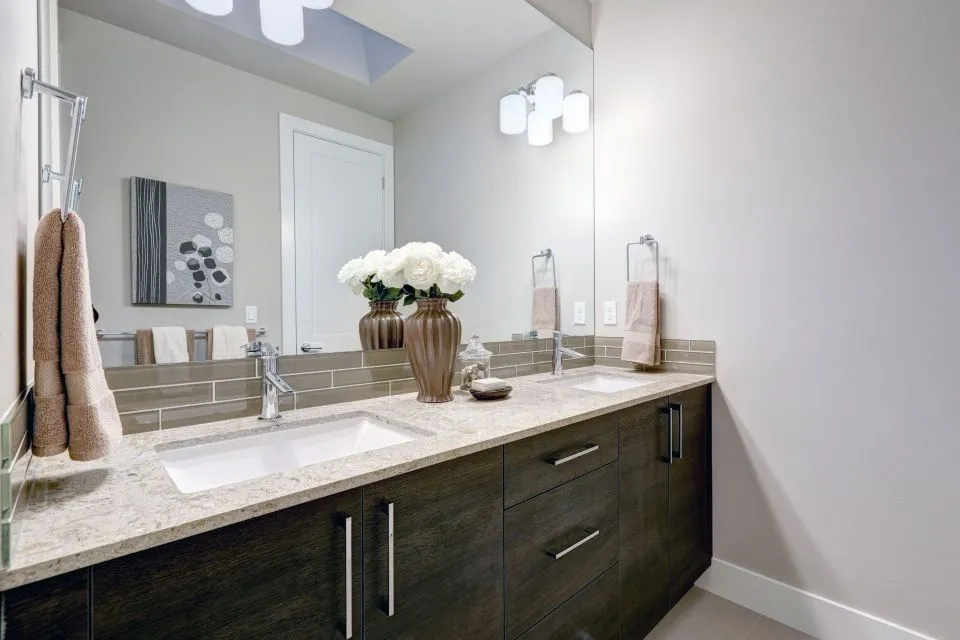
Choosing a farmhouse countertop for an apron-front sink
A farmhouse kitchen with an apron-front sink depends on balance. The benchtop needs enough visual warmth to suit timber cabinetry and classic hardware, while its structure must support a broad, heavy basin. The best surface also needs to cope with everyday mess: muddy vegetables, hot cookware, red wine, school-lunch preparation and the occasional overflowing pot.
Material selection becomes especially important around the sink. Water can collect along the front edge, tapware creates splash zones, and the exposed apron may sit close to the benchtop seam. A well-made installation should have carefully finished edges, a secure cabinet frame and a surface chosen for the household’s cleaning habits.
Australian homes add a few practical considerations. A Queensland kitchen may deal with high humidity and strong sunlight, while a Melbourne or Hobart renovation may prioritise warmth and resilience during long, cool winters. Renovation timelines can also be shaped by local trades, stone suppliers and council requirements, especially when a kitchen alteration affects plumbing, electrical work or structural walls.
Engineered stone also needs careful checking in Australia. Since the national prohibition introduced on 1 July 2024, businesses cannot process, supply or install engineered stone benchtops, panels or slabs covered by the rules. Product classifications and state or territory requirements should be verified before ordering, so a material described casually as “quartz” is not automatically treated as suitable for a new installation.
Quartz-style surfaces and the changing Australian market
Quartz has traditionally been a popular choice for farmhouse kitchens because it offers consistent colour, low routine maintenance and a broad range of soft whites, greys and stone-like patterns. Those qualities work well with shaker doors, oak shelves and a white ceramic apron-front sink. A lightly veined surface can provide the look of marble without placing natural veining across every section of the room.
For an Australian renovation, however, the word quartz needs closer attention. Many quartz-composite products are classed as engineered stone, and the national prohibition affects the processing and installation of regulated products. Importers, fabricators and homeowners should confirm whether a slab is legally permitted, what it contains and whether the supplier can document its compliance. A kitchen company working in the United States may discuss quartz as a standard option, but Australian availability and workplace rules are different.
Where a compliant alternative is available, a honed or matte finish can feel particularly appropriate in a farmhouse setting. It reduces the highly polished appearance that may clash with aged timber and antique-style fixtures. Before committing, request a full-size sample or visit a showroom, because white surfaces can look creamier under warm pendant lights and bluer beside a stainless-steel appliance.
A local fabricator’s consultation should cover sink cut-outs, edge profiles, joins and cabinet support. The kitchen services offered by a specialist fabricator typically include measurements, templating, edging and installation, which are essential when a large apron sink must align precisely with the front of the cabinetry.
Granite for texture, strength and everyday character
Granite remains one of the most dependable surfaces for a busy country-style kitchen. Each slab has natural variation, so it brings depth that pairs naturally with timber, painted cabinets and aged brass. Brown, charcoal, cream and softly mottled grey granites can make a white farmhouse kitchen feel grounded rather than overly new.
A granite benchtop is well suited to households that cook frequently. It is resistant to heat and generally handles ordinary knocks well, although it can still chip at exposed corners or around a poorly supported sink cut-out. Sealing is part of ownership. The timing depends on the particular stone and the sealer used, but the surface should be checked periodically rather than treated as permanently stain-proof.
The slab’s pattern deserves attention beside an apron-front sink. A strongly directional or heavily speckled granite may look busy across a long island, while a quieter slab can frame a dramatic ceramic basin more effectively. A 40-millimetre laminated edge can create substantial farmhouse proportions, but a slim edge may suit a smaller Australian kitchen where visual space is limited.
Granite also performs well in homes that open onto an outdoor entertaining area, though indoor and outdoor applications still require different advice. In a Brisbane or Darwin setting, sunlight through large windows can affect surrounding cabinetry and finishes even when the stone itself remains stable. Samples should be viewed in the actual room, at different times of day, before the slab is selected.
Marble when patina is part of the design
Marble gives a farmhouse kitchen an unmistakable sense of age and craftsmanship. Carrara, Calacatta and other pale marbles can sit beautifully with an undermount or apron-front sink, especially where the design includes timber, unlacquered brass, open shelving and handmade tiles. The soft veining makes a room feel individual rather than assembled from identical manufactured components.
Its main drawback is that marble records use. Acids such as lemon juice, vinegar and some cleaning products can etch the surface, leaving a dull mark. Oils and strongly coloured foods may stain if spills are ignored. Those changes are often called patina, and some homeowners value the lived-in appearance; others want the surface to remain visually uniform.
A sink apron increases the need for good detailing. Water should not sit against an unprotected edge, and the front of the benchtop must be finished smoothly without a fragile sharp corner. A quality sealer can reduce absorption but cannot make marble maintenance-free. Daily wiping with a pH-neutral cleaner is more suitable than abrasive powders, bleach or acidic sprays.
Marble is often a strong choice for a baking zone or a smaller preparation area rather than every surface in a large family kitchen. A marble island can become the feature, while granite, porcelain or another suitable material handles the heavier-use perimeter. This approach preserves the character of natural stone while keeping maintenance manageable.
Porcelain and Dekton for a cleaner-lined farmhouse
Porcelain slabs offer a practical route for homeowners seeking a stone appearance without selecting regulated engineered stone. They can reproduce the look of marble, limestone or concrete, and some designs have enough tonal movement to work with a relaxed farmhouse palette. Their low porosity makes them attractive around a sink, where splashes and food spills are routine.
The fabrication process requires experience because porcelain is hard but comparatively unforgiving at corners and cut-outs. An apron-front sink needs accurate templating, proper support and a cut-out designed for the chosen slab thickness. A narrow edge or exposed corner can be vulnerable if handled carelessly, so the fabricator should explain the recommended profile and reinforcement before production begins.
Dekton and similar ultra-compact surfaces can bring a more contemporary note to a farmhouse room. A warm stone pattern can bridge modern appliances and traditional cabinetry, while a concrete-inspired finish suits black tapware and simple timber. These materials are dense and durable, but installation is highly dependent on specialist cutting, transport and support.
For homes in coastal New South Wales or Western Australia, low absorption can be useful where the kitchen connects closely to a patio or the household often returns from the beach with wet hands and sandy equipment. Porcelain and compact surfaces still need correct cleaning, and the slab edges should be protected from impact. The material is robust, not indestructible.
Practical checks before ordering
- Confirm whether the product is permitted under Australian engineered-stone rules
- Match the slab thickness to the sink and cabinet support
- Inspect a large sample in natural and artificial light
- Ask how cut-outs, joins and exposed edges will be finished
Timber, soapstone and mixed-material schemes
Butcher block or solid timber can be the most convincing match for a traditional farmhouse kitchen. Spotted gum, blackbutt, oak and other timber tones connect the benchtop to Australian building traditions while adding warmth beside a white ceramic sink. A timber island is especially effective when the perimeter uses a more water-resistant material.
Timber needs a protective finish and a sensible splash-zone design. Repeated wetting beside the sink can cause swelling, staining or movement if the edge is not sealed properly. Water should be wiped away rather than left to sit, and the finish may need renewal over time. Timber is also more vulnerable to knife marks and hot pans, although these signs can be repaired or incorporated into its character.
Soapstone creates a darker, quieter alternative. Its charcoal colour works with cream cabinetry, pale walls and aged metal, and its natural softness gives it a gently honed appearance. It is relatively heat tolerant and can be refreshed with specialist oil, but it may scratch more easily than granite. Those marks can sometimes be blended or accepted as part of the surface’s evolving finish.
Mixed materials allow the apron sink to remain the visual centre. Timber on an island, soapstone around the sink and porcelain along a cooking run can divide the kitchen into useful zones. The transitions should be planned around cabinetry lines rather than placed randomly, and the colours should share an undertone so the room feels collected.
Details worth deciding early
- Choose whether the surface should age visibly or stay consistent
- Plan the sink, dishwasher and bin positions together
- Select an edge profile that suits the cabinet scale
- Allow for Australian lead times, access and installation scheduling
Designing the cabinet and sink connection
The benchtop material cannot compensate for a weak sink cabinet. An apron-front basin is heavier than many standard undermount models, particularly when made from fireclay or thick cast material. The cabinet usually needs a purpose-built support frame, with the front rails modified so the sink apron sits correctly without forcing weight onto the slab.
Measurements should be taken after the cabinets are level and fixed in place. Walls in older Australian homes may not be perfectly straight, and a farmhouse renovation in a Queenslander, Federation cottage or rural property can contain surprises behind the existing cabinetry. A template made too early may leave uneven reveals, a misaligned tap hole or a sink that does not sit square to the front edge.
The front edge should project enough to protect the cabinet doors and create a comfortable working position, but too much overhang can make the sink feel disconnected. The fabricator should coordinate the benchtop thickness with the sink manufacturer’s instructions, tapware location, splashback and dishwasher clearance. These details matter more than selecting a fashionable colour.
A farmhouse kitchen also benefits from a considered splashback. Matching the benchtop up the wall can create a calm, continuous backdrop, while handmade-look tiles add texture and colour. Porcelain panels, marble, granite offcuts or a simple tiled surface can all work, provided the junction behind the sink is sealed neatly and remains accessible for cleaning.
Finding the right balance of beauty and maintenance
The most suitable surface is the one that matches the way the kitchen will be used. A household that welcomes scratches, rings and small stains as evidence of daily life may enjoy marble or timber. A busy family wanting quick clean-up may prefer porcelain, granite or another low-absorption surface. There is no single farmhouse material that suits every routine.
Colour also affects maintenance. Very pale surfaces can show coffee, tomato and muddy water quickly, while very dark honed surfaces may reveal dust, fingerprints and dried droplets. Mid-tone grey, warm taupe and softly patterned stone often provide a forgiving middle ground without losing the classic farmhouse mood.
The Countertop Store’s custom surface work includes options such as granite, porcelain, marble, Dekton, soapstone and butcher block, as well as custom features including integrated sinks, fireplaces and furniture pieces. Looking at a fabricator’s range can help clarify which edge treatments, splashbacks and special details are possible for a particular design.
For an Australian project, compare samples with the floor, cabinet paint, appliances and natural light before approving the slab. Check the supplier’s current product status, fabrication capabilities, warranty terms and installation schedule. A carefully selected surface, accurately templated around the apron sink, will give the kitchen the relaxed character of a farmhouse room without sacrificing the practical demands of modern living.