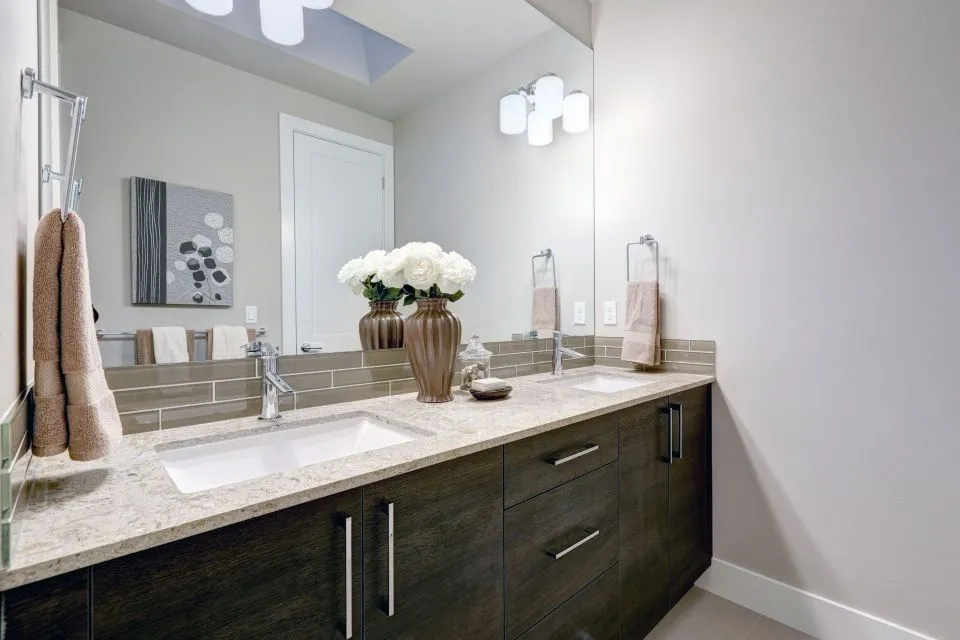
Seamless and visible seams in granite benchtops
Granite remains a popular choice for Australian kitchens because it combines natural character with excellent resistance to heat, scratching and everyday wear. Every slab has its own movement, mineral pattern and colour variation, so the finished benchtop feels individual rather than mass-produced. When a design requires more than one slab, however, the join between pieces becomes an important part of the planning process.
A “seamless” granite benchtop usually means a join that is extremely difficult to notice, rather than a surface made from one uninterrupted piece of stone. A visible seam is a join that can be seen or felt more readily. Both options can be structurally sound and attractive; the difference generally comes down to slab layout, stone appearance, joint placement, fabrication quality and the expectations set before installation.
What a granite seam actually is
Granite is quarried in large slabs, but those slabs have practical size limits. A long island, a broad U-shaped kitchen or a benchtop with several corners may need two or more pieces. Fabricators cut those pieces to suit the cabinet plan and bond them together with a colour-matched epoxy or polyester adhesive.
The seam is usually a narrow line where the two cut edges meet. It is not a crack, and a properly fabricated join should not compromise the strength of the benchtop. The adhesive fills the small gap and holds the adjoining sections together, while the cabinetry beneath provides essential support.
In everyday conversation, “seamless” can therefore be a slightly misleading term. Granite cannot be fused into one continuous natural slab once it has been cut, and a close inspection under strong light may reveal the join. In practical terms, a seamless-looking finish is one where the seam blends with the stone and does not draw attention during normal use.
What makes a seam easy to see
The colour and pattern of the granite have a major influence. Uniform black, white or grey granite can show a join because the eye notices even a fine change in tone. However, a carefully colour-matched seam in a consistent stone may become very discreet. Granite with strong veining, speckles or flowing mineral movement can either hide the line or make it more noticeable, depending on whether the pattern continues naturally across the join.
Finish also matters. A polished surface reflects light and may reveal a narrow line from certain angles, especially near a window or beneath bright pendant lights. Honed and leathered finishes can soften reflections, although their texture may make the adhesive line more noticeable if the edges are not prepared precisely.
The width and quality of the cut are equally important. A straight, well-supported join with clean edges will generally look neater than a poorly aligned connection. If the cabinets are out of level, the slabs can shift slightly during installation, creating a step or uneven line. This is why professional templating and accurate cabinet preparation are central to the appearance of a granite benchtop.
The benefits of a seamless-looking finish
The main benefit is visual continuity. A discreet seam allows the granite to read as one broad surface, which suits minimalist kitchens, waterfall islands and designs with long uninterrupted runs. It also keeps attention on the stone itself rather than on the fabrication detail.
A well-executed join can make cleaning easier because there should be no substantial recess for crumbs, dust or moisture to collect. The epoxy is finished flush with the stone, creating a smooth transition across the benchtop. Regular cleaning remains important, particularly around a sink, but the seam should not behave like an open gap.
A seamless-looking finish is especially valuable in compact Australian kitchens, where strong daylight can make small details stand out. In a Brisbane renovation with a bright outdoor outlook, or a Melbourne kitchen with large north-facing windows, the direction of light can affect how visible a polished seam appears. Viewing samples in the actual room is often more useful than judging them under a showroom’s controlled lighting.
When a visible seam can be the sensible choice
A visible seam is sometimes unavoidable when the design is larger than the available slab or when the layout includes several corners, cut-outs and changes in direction. A join may also be required to manage the weight of a large island during transport and installation. Trying to eliminate every seam can lead to excessive handling, higher costs or an inefficient slab layout.
In some kitchens, deliberately placing the seam in a less prominent area is the smarter design decision. A join beside a cooktop, beneath a raised breakfast bar or close to a sink may attract less attention than one across the centre of an island. The final position depends on the slab pattern, cabinet dimensions and the direction in which people normally approach the benchtop.
A visible seam can also suit a more traditional or natural interior. Granite is a geological material with variation, and a carefully finished join does not have to look like a defect. Homeowners undertaking renovations often refer to their installer as a “tradie”, and a good tradie will explain where the join must go rather than promising an impossible result. Clear planning is better than discovering the seam after the stone has been installed.
Seam placement, support and installation quality
Before fabrication, the installer should review the slab layout and mark likely joins on the approved drawing. This is the stage to consider sink cut-outs, cooktop openings, drainer grooves, dishwasher clearances and corner radii. A seam close to a narrow strip of stone or a high-stress cut-out may be less desirable than one placed in a broader, well-supported section.
The cabinets must be level, square and adequately supported before the granite is brought to site. Even a beautifully polished seam can become apparent if the base units move or the slab is forced into position. Long overhangs, breakfast bars and islands may need brackets, legs or other structural support, particularly where people might lean on the edge.
Installation conditions matter in Australia as well. Long slab sections may need careful access planning in established homes, apartment buildings and narrow suburban blocks. A crane lift, stairwell measurement or temporary removal of a window can sometimes be part of the logistics. In regional areas, slab availability and travel distance may also influence whether matching pieces can be sourced quickly, so the material should be selected and reserved early.
For a broader view of available kitchen surfaces and fabrication options, homeowners can review these kitchen services while comparing layouts, edge profiles and installation requirements. The important point is that seam appearance begins with design decisions well before the adhesive is applied.
Choosing the right granite for a discreet join
When a low-visibility seam is the priority, ask to see a large sample or the actual slab rather than relying on a small showroom chip. Small samples rarely show the full direction of veining and may hide colour changes that become obvious across a two-metre island. A digital slab image can help with early planning, but it should not replace viewing the selected stone in person.
Granite with moderate movement often gives the fabricator useful opportunities to align the join with natural variation. Extremely bold veining can produce a beautiful result, but matching the pattern across two slabs may require extra material and more detailed layout work. Very uniform stones can also look excellent, although the straight line of the seam may be easier to detect.
The edge profile can help complete the effect. A simple eased or pencil edge keeps the design clean, while a more decorative edge may suit heritage homes or formal interiors. The edge should be finished consistently on both sections, with no sharp transition at the join. In coastal areas such as Perth or the New South Wales coast, normal cleaning and sensible sealing remain important, but salt air does not remove the need for accurate fabrication.
Cost, maintenance and realistic expectations
A granite benchtop with a highly discreet seam may cost more when it requires premium slabs, careful pattern matching, additional material or complex handling. The price is also affected by thickness, edge details, sink and cooktop cut-outs, access conditions and the number of pieces needed. Choosing a stone solely because it appears seamless in a small sample can create disappointment if the wider slab behaves differently.
Maintenance is generally straightforward. Wipe spills promptly, use a pH-neutral stone cleaner and avoid abrasive products that could dull the polish around the join. Granite should be sealed when recommended by the fabricator, with the frequency depending on the stone’s porosity and use. A seam should not be scrubbed aggressively or treated as a separate groove.
It is also worth comparing granite with other benchtop materials according to the room and lifestyle. A butcher block surface creates a completely different visual effect and may suit a warm, tactile kitchen, although it needs different care around water and heat. Guidance on installing a butcher block surface over existing laminate is available in this butcher block guide, which illustrates why substrate preparation matters for any countertop material.
The best outcome comes from agreeing on realistic expectations before fabrication: where the seam will sit, how visible it may be under different lighting, which pattern direction will be used and what support the cabinetry requires. A seam that is thoughtfully planned, accurately cut and professionally installed can look refined for many years, whether it is almost invisible or intentionally part of the benchtop’s natural character.