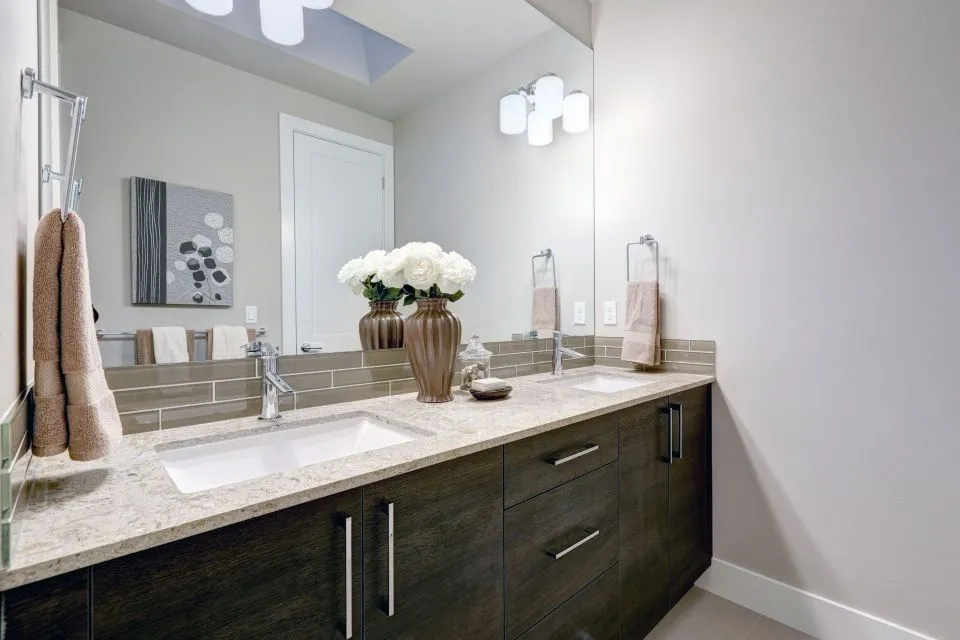
Honed vs polished granite for a vanity top explained
Granite has long been a favourite in Australian renovations, and for good reason. It handles everything from morning shaves to toothpaste splashes and still looks the part a decade later. The bit that catches plenty of renovators off guard, though, is the finish. A slab you see sparkling in a Cleveland showroom can look completely different once it's honed, and that single decision shapes how your bathroom feels and functions every day.
For a vanity top, the finish is the surface you'll touch every morning, the one that catches the light from your window, and the one your guests will run their hand across. Getting it right means weighing looks, cleaning routines, and the realities of your specific bathroom — whether that's a steamy Sydney ensuite, a breezy Gold Coast powder room, or a busy family bathroom in Adelaide where the kids seem to track half the garden in with them.
What honed and polished granite actually mean
Before comparing the two side by side, it helps to understand what fabricators actually do to create each finish. Granite is quarried in massive blocks, then cut into slabs. At that stage, the surface is rough and flat, somewhere between a chalkboard and fine sandpaper. From there, the slab goes through a series of increasingly fine grinding pads — and the final step determines whether you end up with a honed or polished result.
A polished finish is created by continuing that grinding process all the way through to very fine buffing pads, often finishing with a compound that brings out a mirror-like shine. Light bounces off the surface, colours appear deeper, and the natural mineral patterns — the little flecks of mica, the dark veins, the smoky patches — all pop with extra contrast. It's the look most people picture when they hear the word "granite".
A honed finish stops earlier in the process, before the high-gloss stage. The slab is ground smooth enough to feel silky to the touch, but the reflective layer is left off. The result is a matte or satin surface, sometimes described as having a soft, almost velvet-like quality. The colours stay true to the stone's natural state, but the overall look is more understated and contemporary than a traditional mirror polish.
Look and feel: how each finish changes the stone
The visual difference between the two finishes is striking once you see them side by side. Polished granite reflects its surroundings — overhead lights, window frames, the person standing in front of the mirror. In a small ensuite, that reflectivity can either amplify the available light or turn the benchtop into a constant distraction. Honed granite, by contrast, absorbs light. The slab feels grounded and calm, which is a big reason it's become the go-to choice in newer Australian builds aiming for that quiet, understated luxury.
Texture under your fingertips is the other big shift. A polished slab feels glassy and cool, sliding easily under a wet hand. A honed slab has a faint grippiness that some people love and others find unusual at first. In a vanity top, that slight texture can actually be a small safety win — wet hands, toothpaste tubes, and glass jars are less likely to skitter across the surface first thing in the morning.
Colour reading also changes between the two. Take a popular granite like Black Pearl or a warm brown Juparana: in a polished finish the dark base looks almost liquid, and the mineral flecks gleam. Honed, the same slab reads as softer, more chalky, with the pattern still visible but less theatrical. If you're working with a lighter stone such as Colonial White or Kashmir White, honing tends to mute any pink or rose undertones, which can either be a relief or a disappointment depending on the look you're chasing.
Durability and wear in real Australian bathrooms
Both finishes are made from the same granite, so the underlying stone is equally hard — granite scores around 6 to 7 on the Mohs scale and shrugs off scratches from razors, glass bottles, and dropped hairbrushes. Where the finishes diverge is in how they show wear over time.
A polished granite vanity top is famously resistant to staining, because the polishing process closes the pores at the surface. Spilt wine, fake tan drips, or that blue toothpaste your teenager squeezes everywhere bead up rather than soak in. The catch is that polished surfaces show water spots, soap residue, and fingerprints more visibly — and in areas with hard water, like much of Adelaide and parts of regional Western Australia, those marks can build up into a cloudy film that needs regular wiping to keep the shine alive.
Honed granite is a touch more porous at the surface, so a quality sealant is non-negotiable, especially in bathrooms where steam, hair products, and moisturisers come and go daily. Once sealed properly, though, a honed vanity top hides the small stuff beautifully. A few water spots, a smudge of hair product, a faint handprint — none of it reads as dirt the way it would on a polished slab. For busy family bathrooms or rentals where the vanity gets used hard, that forgiving nature is a real plus. In humid coastal areas around Brisbane or the Sunshine Coast, where bathroom ventilation isn't always perfect, honed granite also tends to mask the faint haze that moisture can leave on a glossy surface.
Cleaning, sealing, and day-to-day maintenance
Maintenance expectations are where many homeowners make their final call. Polished granite is often described as the "set and forget" option. A wipe-down with warm water and a pH-neutral cleaner, a soft microfibre cloth, and the occasional reseal every few years is usually enough to keep it looking sharp. Avoid acidic cleaners — vinegar, lemon juice, standard bathroom sprays with harsh chemicals — because they can etch even a sealed surface over time.
Honed granite asks for a slightly more attentive routine, mainly because of that increased surface porosity. Sealing matters more, and it's worth doing a simple water test every year or so: flick a few drops onto the surface, leave them for a minute, then wipe. If the water beads, the seal is intact. If it darkens the stone and soaks in, it's time for a fresh coat of penetrating sealer. The good news is the cleaning itself is forgiving — any non-acidic stone cleaner works, and you don't need to polish or buff the surface to keep it looking presentable.
For Australian households juggling sand from the kids' cricket practice, sunscreen residue from the surf club mornings, and the daily rush of school and work, that low-fuss quality matters. Many homeowners renovating in suburbs like Parramatta, Carlton, or Fortitude Valley find themselves leaning toward honed granite precisely because it forgives the chaos of a lived-in bathroom. If you'd like to compare the actual slabs and finishes available, the stone materials range is worth a browse before you commit.
Choosing the right finish for your vanity top
Style, not just practicality, often decides the matter in the end. Polished granite suits traditional bathrooms, Hamptons-style ensuites, and spaces where you want the vanity to feel like a piece of jewellery — paired with chrome tapware, classical mirrors, and shaker cabinetry, it still reigns. It's also worth picking if your bathroom is short on natural light and you want the benchtop to help bounce what little there is around the room.
Honed granite is the natural partner for modern, coastal, and Scandi-inspired bathrooms, which happen to be the most-requested looks in current Australian renovations. Pair it with brushed brass or matte black tapware, finger-tile splashbacks, and warm timber vanities and you have a combination that feels both current and timeless. Coastal homes from the Mornington Peninsula to Noosa are particularly fond of honed surfaces, because the matte finish complements the relaxed, slightly weathered palette these homes lean into.
A few practical checkpoints before you sign off the order: think about how much natural light your bathroom gets, who uses the vanity and how roughly, whether you deal with hard water or heavy humidity, and how much wiping you're realistically going to do on a Sunday morning. If your answers lean toward "lots of light, careful users, soft water, and I love a bit of shine," polished will suit you well. If they lean toward "limited light, busy household, humid climate, and I prefer things to look good with minimal effort," honed is the safer bet.
Either way, granite remains one of the more generous choices for a vanity top — it outlasts trends, handles the realities of daily use, and adds genuine value to a renovation. The finish just shapes the personality.