Understanding Countertop Edge Profiles for a Finished Look
A countertop edge profile is the shaped transition between the surface and its exposed sides. It influences how a kitchen island feels, how a vanity complements the bathroom, and how comfortable a work area is during daily use. Although the edge occupies only a small portion of the slab, it can strongly affect the character of the entire room.
Edge details range from simple eased corners to layered, decorative shapes. Some profiles emphasize the pattern in natural stone, while others create a quieter outline that lets cabinetry, backsplash tile, or hardware take visual priority. The right choice depends on the material, room style, maintenance expectations, and the way the countertop will be used.
A professional fabricator can help coordinate the edge with sink cutouts, cooktop openings, backsplashes, shower surfaces, and other custom elements. For homeowners in North Little Rock and nearby Arkansas communities, understanding the available options makes the design consultation more productive and helps prevent surprises during fabrication.
What a countertop edge profile does
The edge profile defines the shape of the exposed countertop perimeter. A square edge may present a crisp, architectural appearance, while a rounded edge softens the silhouette and reduces sharp contact points. Decorative edges add contours that can make a peninsula or island feel more like custom furniture.
Profiles also affect how a slab’s thickness is perceived. A standard edge may show the true thickness of the quartz, granite, porcelain, or marble. A laminated edge uses additional material to create the appearance of a thicker slab, often with a more substantial or formal effect. This can be useful on large islands where a thin visual line may seem out of proportion.
The edge must be fabricated with the selected material in mind. Some stones support intricate shaping, while thin porcelain or large-format surfaces may call for a more restrained profile. Fabrication equipment, slab thickness, seams, corners, and installation conditions all influence which edge options are practical.
Popular profiles for kitchens and bathrooms
An eased edge is one of the most versatile choices. The top corner is slightly softened rather than heavily rounded, giving the countertop a clean outline while making the edge more comfortable and less vulnerable to chipping. It works well with contemporary, transitional, and traditional cabinetry.
A straight or square edge creates a sharp, minimalist appearance. The corner may still receive a tiny bevel or safety easing, since a completely sharp stone corner can be uncomfortable and fragile. This profile pairs especially well with modern kitchens, flat-panel cabinets, waterfall islands, and simple bathroom vanities.
A bevel edge removes a small portion of the top corner at an angle. The cut catches light and adds a subtle line of definition without becoming ornate. A larger bevel can bring more emphasis to the countertop perimeter, while a narrow bevel offers a restrained detail for clean-lined designs.
Bullnose profiles curve smoothly from the top surface toward the front or underside. A full bullnose has a rounded appearance, while a demi-bullnose curves primarily along the upper portion of the edge. These options are comfortable around busy kitchen work zones and can make a countertop feel softer and more approachable.
Ogee and similar decorative profiles combine curves, steps, or concave details. They are often selected for traditional kitchens, formal bathrooms, and furniture-style islands. Because the shape is visually prominent, it generally works best when the room has enough space and architectural detail to support it.
How material changes the right choice
Quartz is compatible with many popular edge treatments, including eased, bevel, bullnose, and selected decorative profiles. Its consistent pattern can make a shaped edge look uniform, while a bold veined design may benefit from a simpler outline. Reviewing the available countertop materials early helps connect the profile decision to the slab’s color, movement, thickness, and finish.
Granite often looks effective with a softened edge that reveals the depth and natural variation of the stone. A more elaborate profile can suit richly patterned granite in a traditional setting, though a simple eased edge may be preferable when the slab already contains strong movement. The stone’s grain and mineral composition should be considered near corners and cutouts.
Marble can support elegant rounded or decorative edges, particularly in classic bathrooms and formal kitchens. Since marble can etch and show wear, a profile with gentle transitions may be easier to live with than a highly detailed edge that creates additional surfaces to clean. Fabricators also assess the slab for natural fissures before shaping intricate sections.
Porcelain and Dekton are valued for their durability and contemporary appearance, yet their fabrication requirements differ from those of thicker natural stone. Slim, crisp profiles often complement these materials, especially in modern interiors. A fabricator should verify edge limitations, reinforcement needs, corner treatments, and the intended application before the design is finalized.
Soapstone and butcher block bring distinct visual qualities. Soapstone’s soft, tactile appearance suits eased or rounded edges, while butcher block can use a square, eased, or custom-shaped perimeter depending on the finish. Outdoor kitchen surfaces require additional attention to weather exposure, drainage, support, and edge durability.
Comparing edge styles at a glance
The best profile is a balance between appearance, comfort, durability, and cost. A simple edge typically requires less shaping and may be a practical way to keep attention on an expressive slab. Decorative or laminated profiles require more fabrication time and can increase the project budget, especially around a large island.
The following comparison provides a general starting point. Exact pricing and availability vary according to material, thickness, layout, corner details, and the fabricator’s equipment.
| Edge profile | Visual character | Common applications | Practical considerations |
|---|---|---|---|
| Eased | Clean and gently softened | Modern kitchens, vanities, busy work areas | Versatile, comfortable, and usually economical |
| Square with safety bevel | Crisp and architectural | Contemporary kitchens and minimalist baths | Sharp appearance requires softened corners for safety |
| Bevel | Angular highlight along the edge | Transitional and modern designs | Shows light clearly and is easy to coordinate |
| Demi-bullnose | Rounded upper transition | Family kitchens and traditional spaces | Comfortable and softer than a square edge |
| Full bullnose | Fully rounded profile | Kitchens, baths, and high-traffic areas | Smooth to the touch and visually approachable |
| Ogee | Layered curves and detail | Formal, traditional, furniture-style rooms | More decorative and often higher in fabrication cost |
| Waterfall or laminated edge | Thick, substantial appearance | Islands, peninsulas, statement vanities | Requires additional material, planning, and precise joins |
Edge profiles should be reviewed with a physical sample or profile drawing whenever possible. A shape that looks understated on a small sample may become a strong focal point across a long island. Viewing the countertop material, cabinet color, backsplash, and edge together gives a more accurate impression than choosing from a profile name alone.
Matching the edge to the room
A kitchen island is often the best place for a distinctive edge because it is visible from several directions. A laminated or waterfall-style edge can give the island architectural weight, while a simple eased edge keeps the focus on a waterfall side panel, decorative cabinet, or veined slab. The island’s size matters: a wide surface can support stronger detailing than a narrow perimeter countertop.
Perimeter counters usually benefit from an edge that coordinates quietly with the rest of the kitchen. An eased or small bevel profile can maintain a consistent line around sink areas, appliance openings, and corners. If the countertop has dramatic veining, a restrained edge may prevent the design from becoming visually crowded.
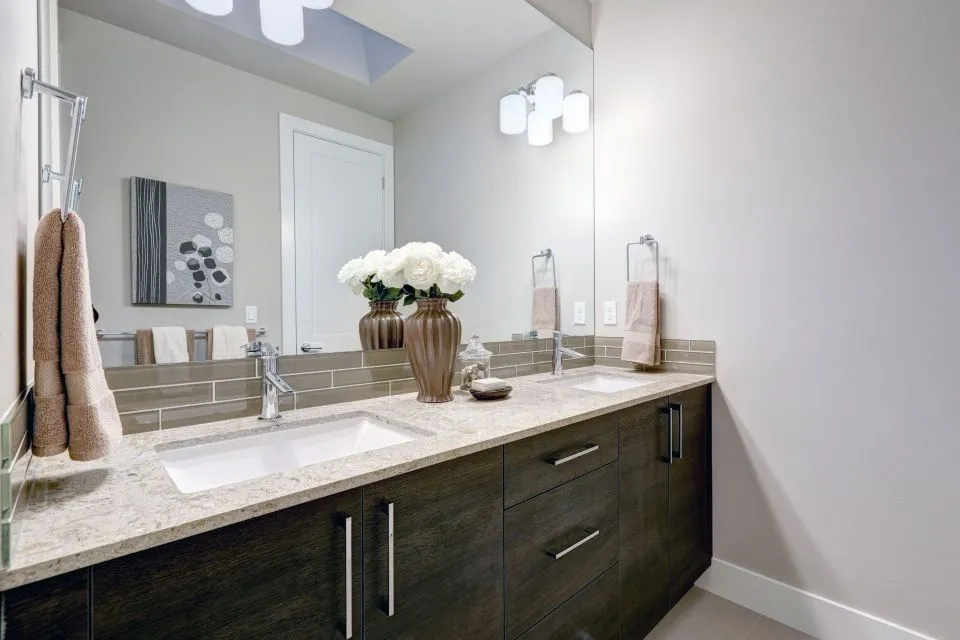
Bathroom vanities have different proportions and usage patterns. Rounded profiles can make a compact vanity feel more inviting and reduce the severity of corners in a narrow walkway. A square or bevel edge can complement linear tile, frameless mirrors, and contemporary plumbing fixtures.
Shower ledges, quartz shower pans, and wall panels need careful detailing around exposed transitions. The selected edge may be smaller and more practical than the profile used on a kitchen island. Water management, cleanable joints, wall alignment, and the relationship between the countertop and surrounding surfaces should guide the decision.
Custom features such as fireplace surrounds, mantels, furniture pieces, and outdoor kitchen counters may call for a profile that reflects the feature’s purpose. A mantel can use a substantial decorative edge, while an outdoor prep counter may need a durable, easy-to-clean shape. The profile should look intentional from every exposed angle rather than being chosen only for the top surface.
Comfort, maintenance, and fabrication details
Rounded edges are generally comfortable in areas where people move frequently or sit near the countertop. They can also reduce the visual harshness of a stone surface. However, rounding the entire perimeter is not always necessary; a homeowner may choose softened outside corners while keeping long runs relatively straight.
Decorative profiles have grooves and transitions that can collect dust, cooking residue, or cleaning solution. This does not make them unsuitable, but it does mean that the edge should fit the household’s cleaning habits. In a frequently used kitchen, a simpler shape may provide a more convenient everyday surface.
Corners deserve special attention. A pointed outside corner can be vulnerable to impact and may feel uncomfortable in a narrow passage. Radius corners, clipped corners, and carefully eased points can improve safety without changing the overall edge style. Sink areas also require enough material support around cutouts, particularly when the slab is thin or the sink is heavy.
The finished profile must be coordinated with templating and installation. Cabinet alignment, overhang depth, support brackets, seam placement, backsplash thickness, and appliance clearances can all affect the final result. A countertop professional typically confirms these conditions before fabrication so the edge design works with the complete installation rather than existing in isolation.
Planning recommendations for your project
A well-chosen profile should support the room’s design for years rather than follow a short-lived trend. Gather cabinet, flooring, backsplash, faucet, and hardware selections before making the final decision. Then compare the profile against the actual slab or a representative sample under the lighting used in the home.
Keep these points in mind during your countertop consultation:
- Choose an edge that complements the room’s overall style instead of competing with a highly patterned surface.
- Consider eased or rounded corners for islands, walkways, bathrooms, and other high-contact areas.
- Confirm that the selected profile is suitable for the material thickness and slab type.
- Ask how the edge affects fabrication time, seams, laminated sections, and the project budget.
- Review the profile at outside corners, sink cutouts, backsplashes, shower surfaces, and exposed ends.
A professional measurement and templating process is especially important when the countertop includes unusual angles, furniture-style details, waterfall panels, or integrated sinks. These elements may require the edge treatment to transition across several surfaces with consistent lines and carefully controlled joints.
The countertop should also be evaluated as part of the broader remodeling plan. A profile that works beautifully on a kitchen island may feel excessive on a small vanity, and an edge selected for an indoor surface may not meet the demands of an outdoor kitchen. Matching the fabrication approach to the location protects both the appearance and performance of the finished installation.
The Countertop Store can help homeowners in North Little Rock, Arkansas, and surrounding areas review material samples, edge options, measurements, and installation details in one coordinated process. Bring your room dimensions, design references, and preferred countertop material to a consultation so the finished edge is selected with the entire project in view. Contact the team to plan a countertop that feels comfortable, fits the space, and gives your remodeling project a polished final detail.