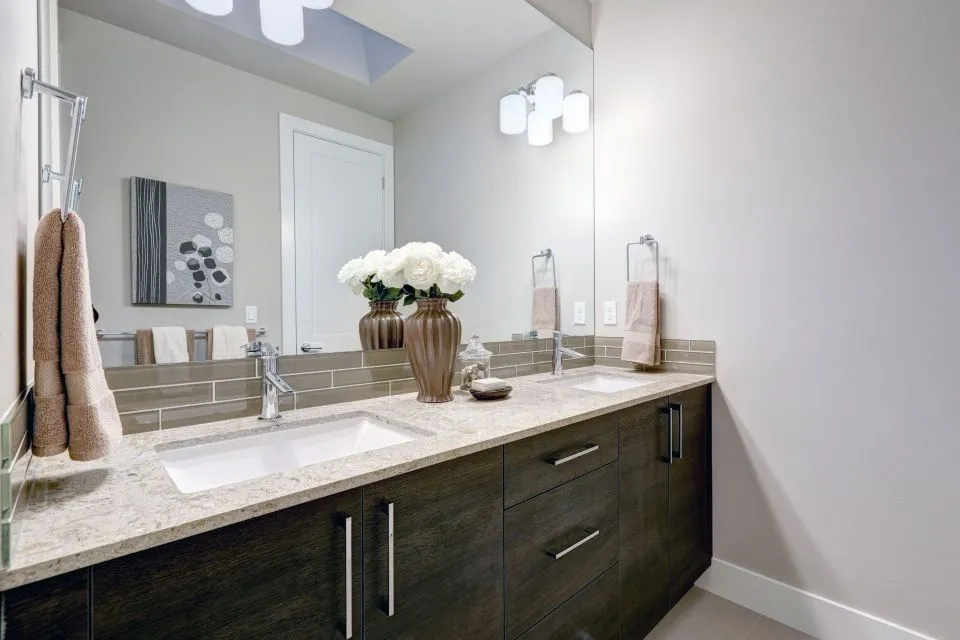
Why a Slab Backsplash Creates a Seamless Look with Your Countertop
Walk into any newly designed Australian home and you will notice the same shift that has quietly transformed kitchens from Adelaide to Brisbane over the last decade. Walls between cooking and living areas have come down, cabinetry is sleeker, and the surfaces around the cooktop now read as a single uninterrupted plane rather than a patchwork of small tiles. A slab backsplash is one of the clearest expressions of that movement, and the visual logic behind it is what makes it so compelling to homeowners planning a remodel.
Rather than relying on dozens of ceramic or porcelain tiles separated by grout lines, a slab backsplash is cut from the same large piece of stone, porcelain, or engineered quartz as the countertop itself. The sheet covers the area between the benchtop and overhead cabinets, or continues to the ceiling where there is no overhead cabinetry. Because the pattern, colour, and finish all come from one continuous source, the eye reads the wall and the bench as a single architectural gesture.
In Australian homes, where open-plan layouts often place the cooking zone in full view from the living and dining areas, the backsplash is no longer a hidden utility surface. It is part of the visual centrepiece. Designers in Sydney and Melbourne have been quick to embrace slab work because it suits the minimalist aesthetic that dominates new builds in coastal suburbs, while renovators in Brisbane and Perth use it to bring warmth and natural movement to homes that lean toward the Hamptons or modern coastal styles.
The seamless effect is also tied to how stone is fabricated today. Modern CNC cutting, waterjet templating, and polished edge work allow fabricators to match veining across two adjoining surfaces, producing a near-mirrored effect that simply was not possible when most kitchens were tiled by hand. The result is a calm, deliberate surface that elevates everything else in the room, from tapware to pendant lighting.
The Continuous Surface Effect
A continuous stone plane changes the way a kitchen is perceived because the human eye is drawn to interruptions. Every grout joint, every change of colour, and every transition between two materials gives the brain another anchor point, which makes a small kitchen feel busy and a large kitchen feel pieced together. When the same slab continues up the wall, those anchors disappear, and the space reads as bigger, calmer, and more expensive than the sum of its parts.
In Australian homes that favour indoor-outdoor flow, this calm matters more than it used to. Terraced houses in inner Sydney and Brisbane's post-war suburbs tend to have narrow, busy kitchens, while renovated California bungalows in Adelaide often combine kitchen, dining, and living into one elongated space. In both cases, a slab backsplash reduces visual clutter and helps the kitchen feel integrated with the rest of the home.
Designers also use the slab backsplash to draw the eye toward a particular feature, whether that is a freestanding cooker, a butler's pantry, or a window above the sink. The uninterrupted surface acts as a backdrop, similar to the way a painted wall frames artwork, which is why many Australian kitchens now pair slab splashbacks with quieter cabinetry finishes in muted tones.
Material Choices That Pair with Your Countertop
Quartz and engineered stone remain the workhorses of slab backsplash design because their controlled veining makes it easier to align the pattern between the benchtop and the wall. Manufacturers can print or press slabs in batches, so a fabricator can book-match two pieces from the same production run so the veining continues across both surfaces. This is particularly effective in popular Australian selections that mimic Calacatta or Carrara marble.
Natural stones such as granite and marble bring their own kind of drama, especially when the slab is selected for dramatic veining or movement. A honed finish softens the reflection and suits the matte aesthetic that has gained ground in Adelaide and Perth, while a polished finish works well in darker schemes common in Melbourne's renovated Victorian terraces. Porcelain slabs, including sintered options like Dekton, have grown in popularity because they handle heat, resist staining, and can be produced in extra-large formats.
Soapstone and butcher block occupy a smaller niche but work beautifully in heritage homes, country kitchens, and the rural properties dotted around Tasmania and regional Victoria. Soapstone in particular develops a soft patina over time, which gives the kitchen a lived-in character that suits the relaxed Australian country aesthetic.
Practical Perks Beyond Good Looks
The slab approach offers more than visual appeal. Grout lines are the weakest part of any tiled splashback because they absorb oils, sauces, and cleaning products, and they slowly discolour over time. A slab backsplash removes those joints entirely, which means there is nowhere for tomato sauce or coffee splashes to settle during the morning rush that defines Australian family kitchens. A wipe with a damp microfibre cloth is usually enough to restore the surface.
Hygiene is another practical consideration, particularly in homes where children are learning to cook or where allergies are a concern. Without grout, there are fewer places for mould and mildew to establish themselves, which matters in Queensland's humid coastal climate and in homes that open frequently to outdoor entertaining areas where sea air and barbecue smoke drift back inside.
Durability is the third quiet advantage. A slab splashback, whether quartz, porcelain, or granite, is heat resistant and, in most cases, scratch resistant. When the family cook uses a gas burner on the highest setting or moves a hot pot near the splashback, the surface tolerates it without scorching. Over fifteen years, this resistance keeps the surface looking like new long after tiled splashbacks would have needed regrouting or replacement.
Australian Conditions and Lifestyle Considerations
Australia presents a unique mix of environmental conditions that affect how a slab backsplash performs. In coastal suburbs from Coogee to Cottesloe, salt-laden air can leave mineral deposits on unprotected surfaces. Dense, non-porous materials like quartz and porcelain handle this exposure well, while marble and soapstone benefit from regular sealing. Local suppliers recommend materials that meet the Australian Building Code's performance criteria for wet areas, particularly behind a cooktop subject to heat and steam.
Bushfire considerations also matter for homes in designated Bushfire Attack Level (BAL) zones across the edges of Sydney, Melbourne, and regional areas. Sintered porcelain products are often specified for these zones because they do not combust and they tolerate radiant heat, which makes them a sensible choice when the kitchen shares a wall with outdoor decking that may be exposed to ember attack.
The Australian preference for outdoor entertaining influences splashback selection in another way. Many homeowners now extend their slab selection from the indoor kitchen out to an outdoor barbecue bench or alfresco bar, creating visual continuity between the two spaces. The same slab that runs up behind the indoor cooktop can be repeated on the outdoor kitchen island, and the effect is striking when guests move freely between the two zones.
How the Fabrication Process Works
A slab backsplash begins with accurate templating, either from finished cabinetry or wall framing depending on build stage. A fabricator visits the home, measures the wall with digital templating equipment, and notes cut-outs for power points and rangehood flues. The slab is selected from the supplier's warehouse, often in the same production batch as the countertop, which is essential when veining needs to align.
Cutting is done on a CNC bridge saw or waterjet, both of which produce precise internal corners and edge profiles tile cannot replicate. Once cut, the slab is hand-finished, edges polished, and the piece transported back to site. Installation usually happens on the same day as the countertop, with the slab adhered to the wall using structural silicone or thinset, depending on the substrate and stone weight. Homeowners who want to see this process in practice can explore fabrication and installation services to understand how a project moves from consultation through to handover.
A good fabricator will also walk the homeowner through care requirements before installation is complete. Most quartz and porcelain splashbacks need little beyond mild detergent and water, while marble, granite, and soapstone benefit from a periodic seal. Establishing them early protects the surface and keeps the kitchen looking as seamless in year ten as it did on handover day.
Cost, Value, and Long-Term Performance
The upfront cost of a slab backsplash is higher than ceramic or porcelain tile, which causes hesitation when the renovation budget is tight. The price difference reflects the cost of the slab itself, often a continuation of the countertop slab, and the labour involved in cutting, polishing, and installing a large, heavy piece on a wall. For a mid-range Australian kitchen, the splashback can add several thousand dollars. Engineered quartz sits in the middle of the range, porcelain and Dekton near the top, and natural stone varies widely based on availability.
What balances the equation is longevity. A well-installed slab backsplash can last the lifetime of the kitchen without regrouting, replacement, or significant maintenance, while tiled splashbacks typically need regrouting within ten to twenty years and often require tile replacement when the grout fails. Over a thirty-year horizon, the slab approach frequently works out to be the more economical option.
Resale value is harder to quantify but worth considering. Buyers touring open homes in suburbs like Paddington, Brighton, and Claremont increasingly expect high-end finishes in renovated kitchens, and a slab backsplash signals a premium renovation even when the cabinetry is mid-range. It is one of the small details that photographs a property well and reads as quality in listing images, which matters in a competitive Australian sales market.
Comparing Slab Backsplash to Traditional Tile
The table below summarises how slab and tiled splashbacks compare on the criteria most Australian homeowners weigh.
| Feature | Slab Backsplash | Traditional Tile |
|---|---|---|
| Visual continuity | One continuous pattern and colour across benchtop and splashback | Multiple tiles separated by visible grout lines |
| Cleaning effort | Wipe with damp cloth, no grout to scrub | Requires scrubbing of grout lines regularly |
| Hygiene | No grout joints for mould or bacteria to hide | Grout can discolour and harbour moisture |
| Heat and stain resistance | High for quartz, porcelain, and Dekton | Variable, depends on tile and grout type |
| Installation time | Usually installed in one day with countertop | Multi-day process with setting, drying, and grouting |
| Upfront cost | Higher due to slab material and fabrication | Lower, with wide range of price points |
| Long-term maintenance | Minimal beyond periodic sealing for natural stone | Regrouting often required within 10–20 years |
| Suitability for open-plan layouts | Strong, reads as a single architectural surface | Can look pieced together in view-through layouts |
| Design flexibility | Limited to the slab pattern chosen | Wide range of colours, shapes, and layouts |
The right choice depends on the homeowner's priorities. A slab backsplash suits those who value a calm, modern aesthetic and want their kitchen to read as one cohesive space, particularly in open-plan homes where the cooking zone is always visible. A tiled splashback suits homeowners who enjoy the texture of handmade ceramic, want a colour unavailable in slab form, or are working to a constrained budget. Either approach can produce a beautiful kitchen, but only the slab approach produces the uninterrupted visual flow that has become the signature of premium Australian kitchen design.