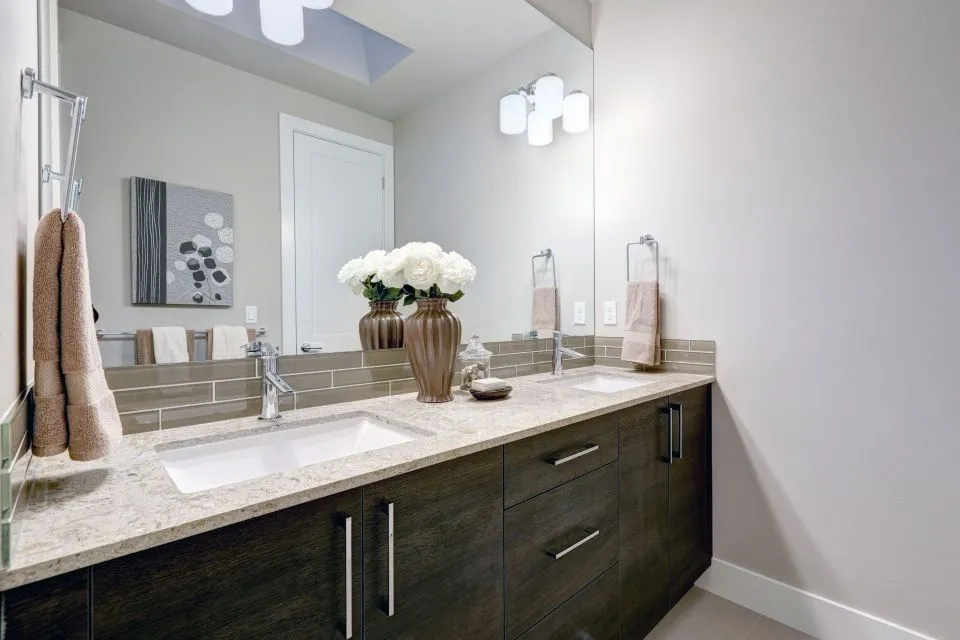
Why a quartz countertop with an integrated backsplash is worth it
Across Brisbane, Sydney, and the leafy suburbs of Melbourne, a quiet shift is happening in Aussie reno projects. Homeowners are pulling up the dated tile splashback and asking their fabricators for something cleaner, something that flows. The integrated backsplash, where the benchtop continues up the wall in one continuous piece, has moved from boutique architectural detail to a mainstream request on the quote sheet.
An integrated backsplash is exactly what it sounds like. Rather than finishing the wall above the counter with tiles, paint, or a separate slab of stone, the same surface is fabricated and installed as a single, unbroken run. The join between bench and wall disappears, leaving a smooth, curved or mitred transition that catches the light and shrugs off spills. For families juggling school runs, weekend footy, and a never-ending list of muddy paw prints, that kind of cleanability is hard to beat.
Quartz has quietly become the go-to surface for this application in Australian showrooms. Engineered stone delivers the consistent colouring that makes a seamless run possible, holds up against red wine splashes and turmeric stains, and comes in a range of neutral and veined patterns that suit both coastal Hamptons-style homes and the more contemporary builds popping up around Perth and Adelaide.
This article walks through the practical advantages of pairing a quartz benchtop with an integrated splashback, where the option genuinely outperforms other materials, and what to ask a fabricator before signing off on the job. It also covers the cost-versus-value picture, because in the Australian renovation market, smart spend matters just as much as smart design.
Understanding the integrated backsplash concept
Most splashbacks are a separate surface. Tiles, glass, or a thin slab of stone sit on top of the wall behind the bench, and the join where they meet the counter is sealed with silicone. That silicone yellows, the grout discolours, and the corner collects dust. A fabricator making an integrated splashback cuts the bench slab and the vertical wall piece from the same block, then joins them with a tight mitre or a smooth curved cove.
The result is a single, monolithic surface that runs from the front edge of the bench, over the lip, and up the wall, often 100 to 150 millimetres high, though some homeowners push it to full-height behind the cooktop. Because the piece is one continuous run, there is no grout to scrub, no silicone to replace, and no visible seam to gather grime in the corners.
The fabrication side of things is what makes this detail possible. A digital template captures the exact dimensions of the bench and wall, the slab is cut on a CNC or waterjet, and the join is polished so the veining flows uninterrupted. This is not a job for a general tiler or a handyman. It is precision stonework, and it sets the stage for everything that follows.
How quartz compares to other surfaces
Quartz is the natural fit for an integrated splashback, but it is worth seeing how it stacks up against the other surfaces on the market. Looking at the criteria that matter most for an integrated splashback, the four common choices compare as follows.
| Surface | Seamless fabrication | Stain resistance | Heat tolerance | Maintenance | Relative cost |
|---|---|---|---|---|---|
| Quartz | Excellent | Excellent | Good | Low | Mid to high |
| Granite | Good (visible seams) | Good when sealed | Excellent | Moderate | Mid to high |
| Porcelain | Excellent | Excellent | Excellent | Low | Mid |
| Marble | Fair | Poor without sealing | Good | High | High |
Granite works, but the natural variation in veining makes the seam more visible, and the porous surface needs regular sealing to stay stain-resistant in a splashback zone. Marble is gorgeous and a common request in heritage-style renovations around Melbourne's inner east, but it etches from acidic spills like lemon juice and vinegar, which is a real drawback behind a cooking bench. Porcelain countertops have become a strong contender in family homes, holding up well to stains and heat, though the colour range is narrower than quartz and edge profiles can be limited by the slab thickness.
For most Australian households, quartz lands in the sweet spot. It gives the seamless finish, the colour consistency, and the low-maintenance surface that suits the way people actually live in their kitchens.
Seamless design that transforms a space
The visual payoff is what sells most people on the idea. A quartz countertop with an integrated backsplash reads as one fluid surface, which makes even a modest kitchen feel more considered. The eye travels from the benchtop up the wall without interruption, so the splashback becomes part of the bench rather than an afterthought tacked on above it.
This matters in compact Aussie kitchens, where every design choice has to earn its keep. Open-plan living is the default in newer builds around the Sunshine Coast and inner-western Sydney, which means the kitchen is always on show from the lounge and dining areas. A clean, uninterrupted run of stone quietly anchors the space and lets the cabinetry, tapware, and pendant lights do the talking.
Colour matching is another quiet win. Because the bench and splashback come from the same slab, the veining or aggregate pattern lines up perfectly. With natural stone, two pieces cut from the same block can still vary noticeably, but engineered quartz is manufactured to be consistent across the entire slab, so the transition looks intentional rather than coincidental.
Hygiene benefits and easy cleaning
For households with kids, the integrated splashback is more than a design statement. The absence of grout lines removes the usual hiding spots for crumbs, splashed pasta sauce, and the sticky residue that accumulates around power points. A quick wipe with a damp cloth and a mild spray cleaner brings the surface back to a finish that looks freshly installed.
Quartz itself is non-porous. Unlike granite or marble, it does not need sealing, and it resists the absorption of liquids that would otherwise stain or harbour bacteria. Red wine from a Sunday arvo catch-up, coffee from the morning rush, beetroot juice from a smoothie bowl — these all sit on the surface long enough to be wiped away without leaving a mark. For anyone running a busy household with multiple people cooking at once, that kind of low-maintenance surface saves real time each week.
The coved or mitred transition between bench and splashback also means there is no lip where oil and water can pool. Some fabricators offer a small radius cove, which creates a soft curve rather than a sharp internal corner, and that curve is even easier to clean than a square join. Ask to see samples of both options before the slab goes on the saw.
Built tough for Australian conditions
Australian homes put surfaces through their paces. The bench takes direct sun through north-facing windows in Perth and Brisbane, coastal humidity in the Gold Coast hinterland, and the occasional slammed-down cast-iron pan from a stir-fry at 8 pm on a Tuesday. Quartz handles most of these conditions well.
Heat resistance is solid, though not unlimited. A trivet is still recommended under a hot pot straight from the oven, because sudden thermal shock can cause discolouration or, in rare cases, cracking. For everyday cooking, though, quartz copes with warm dishes, electric kettles, and the slow heat drift from an underbench oven without a fuss.
Coastal homes benefit from quartz's resistance to salt-laden air, which can pit and corrode some metals and natural stones over time. The UV exposure question is worth raising with your fabricator, because prolonged direct sunlight can cause some quartz colours to yellow or fade over years. South-facing kitchens or those with filtered light through a servery window rarely see this issue, but a fully sun-drenched benchtop deserves a conversation about placement and colour choice before the order goes in.
Long-term value and cost perspective
The integrated splashback costs more upfront than a tiled alternative. The fabrication is more involved, the slab yield has to account for the vertical piece as well as the bench, and the install takes longer. In the Australian market, homeowners should expect to budget roughly 20 to 40 per cent more for the splashback component compared with a standard drop-in slab.
That premium tends to pay itself back in three ways. First, ongoing maintenance is essentially nil. No regrouting, no resealing, no replacing cracked tiles after a heavy pot lands on the bench. Second, the surface adds measurable value at resale. Buyers walking through a renovated kitchen in Sydney's eastern suburbs or Brisbane's inner north notice the detail, and it reads as quality. Third, the lifespan of a well-maintained quartz benchtop easily runs 20 years or more, which spreads the initial cost over decades of daily use.
For homeowners weighing the spend, it helps to compare the integrated option against a high-quality tile splashback installed by a professional tiler. Once you factor in tiles, adhesive, grout, the labour to lay it, and the maintenance over ten years, the integrated quartz option often lands within striking distance on a like-for-like basis.
Choosing the right fabricator and planning the install
The outcome of an integrated splashback lives or dies on the fabricator. The work demands accurate digital templating, careful slab layout to match veining, and a precise cut and polish on the join. A general stonemason who mostly does benchtops may not have the workflow dialled in for vertical pieces, and a mistake at the template stage will show up on the wall for the next twenty years.
When comparing quotes, ask to see recent jobs that include an integrated splashback, ideally in the same colour or pattern you are considering. A reputable fabricator will have a portfolio and will happily walk you through how they handle the join — whether they use a mitre with epoxy, a coved transition, or a tight square butt join. Each approach has a different look and a different cleaning profile, and seeing real-world examples makes the choice far easier than guessing from a sample chip.
It also pays to visit the workshop. Watching how slabs are handled, where joins are glued, and how the polish is finished tells you a lot about the quality control behind the finished install. A good workshop is tidy, well-lit, and staffed by people who measure twice and cut once. If the visit feels chaotic or the slabs are stored badly, that is usually a fair signal of how the install will go.
Finally, lock in the details before fabrication begins. Confirm the splashback height in every section, the position of any cut-outs for power points or rangehoods, and the edge profile on the top of the splashback. Once the slab is cut, changes are expensive. A clear set of drawings and a walk-through on site with the fabricator before the saw spins up will save both money and headaches, and it gives you one last chance to tweak the layout before the stone is gone.